The GDS-Movement: Accelerating the sustainable transition from destination marketing to destination management

Exclusively for Community Index Magazine, GUY BIGWOOD, Chief Changemaker and CEO @ Global Destination Sustainability Movement shared valuable insights regarding the current status and the bright future of destination management.

The Global Destination Sustainability Movement (GDS-Movement) unites and enables destination management professionals to create flourishing and resilient places to visit, meet, and live in. Its mission is to co-create sustainable and circular strategies, mindsets, and skill sets to enable destinations of the future to thrive, and society and nature to regenerate.

For 17 years, Guy Bigwood has been delivering award-winning consulting services focused on helping cities, governments, corporations, and associations to step up, scale up and speed up their sustainability programmes and regenerative practices. Guy’s pioneering work has been recognised with 22 sustainability awards, including the Events Industry Council Pacesetter Award and recognition as a Fellow of the Institute of Environmental Management and Assessment.

1. The Global Destination Sustainability Movement brings together the sustainability pioneers of the business and leisure tourism world and works with destinations to benchmark, measure, and improve their sustainability performance in order to catalyse regeneration. How does the GDS-Movement manage to unite the destination community in order to create flourishing and resilient places to visit, meet, and live in?

GDS-Movement unites destinations based on shared goals to develop the visitor economy so that people, the planet, and profits can prosper. It achieves this in a variety of ways.

It offers the leading sustainability benchmarking and improvement programme for destinations around the world, the GDS-Index.

The GDS-Academy, an immersive learning experience, provides training for event and destination management professionals to turn sustainability concepts into action. Courses like the “Certificate in Regenerative Destination Management” and the “Storytelling and Communication Strategies for Regeneration Masterclass” receive great feedback from the participants.

As a community, we encourage knowledge sharing for all destinations through Feeling the Pulse webinars, white papers, reports, benchmarking insights, and best practice recommendations.

GDS-Movement works with destinations in a consulting capacity to assist their regenerative endeavours in vision and strategy development, capacity building, stakeholder engagement, and communications.

2. The GDS-Index is a benchmarking tool that measures and ranks global destinations based on their sustainability performance in the tourism and events industry. How are the Destination Management Organizations (DMOs) that are benchmarked changing the way they work to become more sustainable?

By participating in GDS-Index, destinations commit to a long-term journey to improve their sustainable contributions with GDS-Movement’s support. They commit to measuring the social, environmental, and economic performance of their tourism and events industry, and then work to improve its performance.

They do this by increasingly engaging, educating, and involving their stakeholders in the co-creation of new solutions. They build their staff and supply chain capacity with tools, sustainability training, standards, and certifications. They empower and support their partners to create new experiences and services in the destination, and to develop a culture of positive storytelling and inspiring communications.

Destinations Tirol, Geneva, Goyang, and Belfast developed noteworthy sustainable strategies with consulting support from GDS-Movement. These strategies are well aligned to the GDS-Index criteria, and therefore to the United Nations Sustainable Development Goals (UN SDGs), making them more comprehensive and impactful.

3. What are the benefits of a global benchmarking system for destinations that evaluates sustainability performance?

Key benefits of joining the leading sustainable destination benchmarking and performance improvement programme include:

1. Benchmark to drive better decision making

2. Gain expert advice to improve strategy

3. Catalyse collaboration and innovation within a destination

4. Offer clients a trusted third-party endorsement

5. Promote a destination’s sustainability story

6. Save money and time – GDS-Movement knows what is necessary to become a regenerative destination.

The winner of GDS-Movement Most Improved Award is a great example – Lyon, France through the Office du Tourisme & des Congres du Grand Lyon. In 2021, Lyon made the most dramatic improvement in one year with a whopping 42% increase in its overall benchmarking score, thanks to year-on-year improvement in the supplier and DMO performance categories. We salute their continued efforts.

4. In 2020, the GDS-Movement team was recognised as the winner of IMEX-EIC Innovation in Sustainability Award, “the Oscars” of the Sustainable Events industry. Why is the MICE industry a powerful accelerator of sustainable development and competitiveness?

Unlike leisure travel, the MICE industry generally involves more participants, which demands more hotel rooms, bigger F&B providers, better transportation systems, and more resources, forming much bigger and more complex value chains. With its larger scope, the MICE industry generates larger impacts, too, which can accelerate sustainable development if approached strategically. MICE has many stakeholders, thanks to its vast supply chain. The knock-on effect of investing in its own sustainability is that it can also empower others to do the same, leading to exponential positive impacts.


5. Which MICE destinations around the world are winning the sustainability race?

We do not see sustainability as a race, as sustainability has no finish line – we can always do more for all to flourish and profit more. Instead, we view it as a regenerative journey that is not about competitive advantage but rather a collaborative advantage.

Destinations like Iceland, Zurich, Vienna, and Hawaii have chosen a 5-to-10-year timeframe to achieve their goals through their sustainability strategy. Other destinations may map their own path appropriate to their capacity and context, and we offer support every step of the way.

We see some destinations in the GDS-Index making amazing progress thanks to their tremendous improvement in the regeneration journey. GDS-Movement awards these destinations with our special ‘Most-Improved Award’ and Goyang (2018), Ireland (2019), and Lyon (2021) have each won the award at a critical stage in their evolution. We hope to see more destinations reaching their pace (and exceeding it!) in the coming years.

6. You consider 2021 “a tipping-point year, not only for increased action in sustainability but also as the year when regenerative thinking started to be more widely integrated into destination management and stewardship plans – the year when destination management really took precedence over destination marketing.“ What can DMOs do to accelerate this Regenerative Revolution and build back better?

We encourage destinations already participating in the GDS-Index to continue this journey as data shows that consistent benchmarking improves overall sustainability performance.

A strong sustainability strategy is the single-most effective tool for positive systemic change, but it often takes a mindset shift to see the value of that systemic change, which our immersive, collaborative learning experience through the GDS-Academy offers.

We invite those destinations not benchmarking to join the GDS-Movement and accelerate regenerative revolution with us. Our knowledge-sharing platforms including Feeling the Pulse webinars, white papers, reports, newsletters and social media, provide insightful information and data to support a destination’s regeneration journey. We support this by developing sustainability strategies or providing in-house workshops and GDS-Academy courses.

7. Unfortunately, some destination marketers only reference sustainability in promotion, as it is something that is not part of their KPIs. What can destination marketers do to encourage a sustainable, post-pandemic tourism experience that would reopen borders and truly revive the tourism economy?

Yes, unfortunately, that is sometimes true. But these destinations will get “caught out” by their stakeholders and at some stage will have to step up and scale up their actions.

Instead of merely marketing a destination, DMO professionals can:  

  • Focus on destination management or “changing the system”, by educating, advocating, and developing new policies and initiatives that will improve the destination and make it a better place to visit.
  • Bring stakeholders together to co-create their destination’s sustainability strategies with shared objectives, indicators, targets, and systematic methods for achieving them.
  • Deepen brand integrity by basing strategic sustainability messaging on goals, actions and results, rather than basing actions on intentions and aspirations.
  • Communicate the destination’s sustainability story consistently, humbly, and honestly, using facts and people-based stories. Not telling your story – “green hushing” – is as damaging as greenwashing. Green hushing is when a destination fails to tell of its efforts (perhaps because it feels they aren’t bold enough); greenwashing is claiming to be doing more than there is evidence for. Our motto in the GDS-Movement is that it’s “Progress over Perfection” that counts!

Convention Tirol is a prime example. With support from GDS-Movement, Tirol created a sustainability strategy and an associated action plan with precise measures. These were developed in a collaborative and co-creative process with interdisciplinary working groups, under the title of “RegenerationNOW“. This sustainability strategy consists of 46 measures which were derived from 4 key objectives and 19 impact goals and are set to be completed within a year. This example serves as an inspiration for other destinations to build a more sustainable post-pandemic tourism experience.

Photo Source: Unsplash

Sediul central al Bancii Transilvania a obtinut cel mai inalt nivel de certificare, BREEAM Outstanding

• BT a obtinut un punctaj de 88,7% la certificarea BREEAM
• Cladirea consuma cu 20% mai putina energie fata de referinta nationala
• Sediul Central al bancii are o suprafata de 38.000 mp si aproape 1.400 de birouri

Sediul Central al Bancii Transilvania, aflat in Cluj-Napoca, pe Calea Dorobantilor 30-36, a primit certificarea BREEAM New Construction, cel mai inalt standard de sustenabilitate si eficienta din industrie, cu un punctaj de 88,7% din 100. Sub 3% din cladirile certificate BREEAM in lume au obtinut standardul Outstanding.

Cladirea BT este functionala din ianuarie 2021, are 38.000 mp, capacitate pentru aproape 1.400 de birouri, 30 de sali de intalniri, 8 bucatarii, amfiteatru, cafenea, restaurant, parcare subterana pentru masini si biciclete, precum si statie pentru incarcarea masinilor electrice. Cladirea a fost construita din materiale certificate, reciclate si reciclabile.

Evaluarea pentru certificare a fost realizata tinand cont de categorii diferite, fiecare primind cate un punctaj: Managementul cladirii, Sanatate si stare de bine pentru angajati, Energie, Transport, Apa, Materiale, Deseuri, Utilizarea terenului si ecologie, Poluare si Inovatie. Punctajul maxim a fost obtinut pentru Management si Transport.

Leontin Toderici, Director General Adjunct Operatiuni, Banca Transilvania, declara: „Investitia in noul Sediu Central al bancii a avut in vedere crearea unui mediu cat mai placut si sanatos pentru angajati, precum si grija fata de mediu. Pentru optimizarea consumului de resurse folosim tehnologii, dotari si facilitati de ultima generatie”.

Adrian Pop, Manager General ADP green building, adauga: „A fost un proiect complex, iar sustenabilitatea si inovatia au stat la baza temei de proiectare si a conceptului cladirii. Sediul Central BT a fost conceput ca si cladire verde inca din etapa de proiectare fiind folosit standardul BREEAM. Impactul asupra mediului si grija pentru conditiile de sanatate si siguranta au fost atent monitorizate pe tot parcursul realizarii acestuia. Suntem mandri ca am facut parte din echipa care a contribuit la realizarea acestei cladiri, una dintre cele mai sustenabile din Romania”.

Detalii despre Sediul Central BT:

• Aerul din cladire este filtrat permanent, iar calitatea acestuia este permanent monitorizata.
• Incalzirea si racirea sunt realizate printr-un sistem de temperare in masa a betonului.
• Nivelul de iluminat la birouri este pastrat constant cu ajutorul lampilor care detecteaza nivelul de lumina naturala si compenseaza in timp real cu iluminat artificial. Lumina este pe baza de senzori, controlata prin BMS (building management system), ceea ce reduce cu aproximativ 30% necesarul de energie pentru iluminat.
• Cladirea consuma cu 20% mai putina energie fata de referinta nationala si cu circa 8% mai putina energie fata de referinta BREEAM.

• Materialele din lemn au certificare FSC sau similara si atesta provenienta din surse exploatate sustenabil.

• In procesul de selectie a materialelor de constructii au fost alese cele cu certificari de mediu precum EPD, BES 6.001 si ISO 14.001.
• Amprenta de carbon inmagazinata a cladirii este de 1.407 kgCO2eq/mp.
• Deseurile sunt colectate selectiv.
• Cladirea este in stil contemporan, cu influente eco si tech – prin concept, materiale, culori, functionalitate, dotari si design. Design-ul cuprinde o combinatie de texturi si materiale – de la beton cu aparenta de lemn, la piatra de Vistea. Cromatica este neutra – predominant in gri, crem si maro.

BREEAM (Building Research Establishment Environmental Assessment Method) este prima si cea mai intalnita metoda de evaluare a sustenabilitatii cladirilor, lansata si administrata de organizatia Building Research Establishment din Marea Britanie.

Articolul a fost publicat initial pe site-ul Bancii Transilvania. Pentru a il accesa: https://bit.ly/3pvCYDb

Cantina socială Kaufland, un model de parteneriat privat cu societatea civilă

În februarie 2021, Kaufland România și Asociația Șansa Ta au lansat prima Cantină socială dedicată sprijinirii persoanelor defavorizate, prin intermediul căreia oferă mese comunitare persoanelor fără adăpost și familiilor cu venituri mici. Proiectul este o premieră în România, un model de parteneriat privat cu societatea civilă, ce vine în sprijinul persoanelor defavorizate și contribuie la diminuarea risipei alimentare.

Studiul de caz a fost publicat iniţial în anuarul bilingv Community Index Magazine nr. 3 2021, ediţie tiparită. Acesta poate fi comandat de aici: https://communityindex.ro/community-index-magazine-2021/

Cantina socială se află în București și oferă mese comunitare în fiecare zi, de luni până vineri. În 6 luni de funcționare, au fost pregătite aproximativ 100.000 de meniuri ce au fost distribuite de reprezentanții Asociației Șansa Ta către persoane fără adăpost, familii cu venituri mici și ONG-uri partenere, care au oferit mai departe porțiile către beneficiarii lor. În primele luni ale anului 2021, cantina a funcționat în regim take-away (luat la pachet), în linie cu restricțiile impuse de autorități. Ulterior, cantina a fost deschisă și pentru a servi masa în interior, având o capacitate de 70 de locuri.

Pentru că risipa alimentară este o problemă globală cu consecințe complexe, Kaufland România își propune ca acest proiect să utilizeze inteligent toate resursele de care dispune. Astfel, compania asigură toate produsele necesare pentru prepararea meselor comunitare, iar parte din alimente provin din stocurile aflate în vânzare accelerată. Meniul este stabilit zilnic și adaptat pentru folosirea optimă a tuturor alimentelor disponibile.

Spațiul cantinei dispune de toate dotările necesare și respectă cele mai înalte condiții igienico-sanitare, fiind compus din bucătărie, unde se depozitează și se pregătește mâncarea, zonă administrativă și cameră tehnică, vestiare pentru femei și bărbați, dar și o zonă de servit cu mese și scaune pentru aproximativ 70 de persoane.

Bucătăria este utilată cu echipamente de gătit moderne: cuptoare, plite, mașini pentru gătit (curățat, tocat, paste etc), frigidere, vitrine, camere pentru depozitare. Printre facilitățile disponibile se numără și sistemele de siguranță, instalații sanitare și de ventilație noi, vestiare cu dușuri, spălătorie pentru echipamentul de lucru, toalete pentru beneficiari, lift pentru persoanele cu dizabilități, dar și o parcare cu 20 de locuri și o zonă de recepție a mărfii.

„Credem că o companie are rolul de a fi partener al comunității și că implicarea face diferența, de aceea ne-am dorit să realizăm acest proiect ce vine în sprijinul persoanelor vulnerabile. Facem constant eforturi pentru diminuarea risipei alimentare, iar prin această acțiune, ne-am propus să folosim inteligent toate resursele de care dispunem și să aducem zâmbetul pe buze celor care au nevoie de ajutor”, a declarat Katharina Scheidereiter, CSR Manager, Kaufland România.

„Ne bucurăm nespus să primim sprijinul Kaufland România și să pornim împreună această inițiativă frumoasă, ce va ajuta atât de mult persoanele fără adăpost și familiile cu venituri mici”, Gabriel Ciobotaru, președinte Asociație Șansa Ta.

Exemple de meniuri:

Supă cremă de ciuperci

Piure de cartofi cu cotlet de porc marinat în iaurt pe grătar și salată verde

Plăcintă cu brânză dulce cu stafide și gutui

Ciorbă de legume

Ratatouille cu cârnați de casă

Griș cu lapte, stafide, scorțișoară și banane

Ciorbă rădăuțeană de pui

Plăcintă cu carne, sos de iaurt și salată verde

Orez cu lapte și scorțișoară și dulceață de măr cu ghimbir

László Borbély, consilierul premierului pe dezvoltare durabilă: Am finalizat sistemul de monitorizare al indicatorilor de dezvoltare durabilă până în 2030

Departamentul pentru Dezvoltare Durabilă, din cadrul Guvernului României, împreună cu Institutul Național de Statistică au organizat pe 27 iulie workshop-ul de consultare cu factorii implicați în procesul de monitorizare și raportare a implementării Strategiei Naționale pentru Dezvoltarea Durabilă a României 2030 privind utilizarea setului național de indicatori de dezvoltare durabilă. Scopul evenimentului a fost acela de a consolida colaborarea dintre Institutul Național de Statistică, ministere și alte instituții furnizoare de date statistice, astfel încât monitorizarea Strategiei de dezvoltare durabilă să funcționeze coerent și unitar.

„Am finalizat sistemul de monitorizare al indicatorilor de dezvoltare durabilă până în 2030. Este clar că nu putem formula politici publice coerente și aplicate fără să avem date. Nu putem monitoriza implementarea Strategiei fără aceste date esențiale. Reprezentanții instituțiilor care trebuie să raporteze indicatorii au primit astăzi informații folositoare privind mecanismul de raportare al celor 291 de indicatori. Nu ne oprim. Am demonstrat că putem face echipă la nivel guvernamental pentru a accelera implementarea Agendei 2030 și vom continua să atragem alături de noi întreaga societate în acest demers”, a declarat consilierul de stat László Borbély.

La rândul său, domnul Tudorel Andrei, președinte al Institutului Național de Statistică (INS), a subliniat complexitatea procesului de consultare între INS şi factorii implicați în furnizarea de date statistice, proces care a ținut seama pe de o parte de armonizarea indicatorilor naționali cu cei europeni și, pe de altă parte, de existența surselor de date administrative și a celor statistice. De asemenea, preşedintele INS a subliniat necesitatea actualizării permanente a listei de indicatori statistici astfel încât INS să poată furniza factorilor decidenți date statistice relevante, pertinente și de interes.
În finalul cuvântului adresat participanților la această întâlnire, domnul Tudorel Andrei a reiterat importanța acestui proiect în conturarea și modernizarea sistemului de indicatori statistici de dezvoltare durabilă.

Pe parcursul workshop-ului au fost prezentate informații referitoare la stadiul actual al proiectului și a fost prezentat Ghidul referitor la setul național de indicatori de dezvoltare durabilă pentru autoritățile publice implicate în procesul de monitorizare și raportare a SNDDR 2030, utilizat în măsurarea implementării Țintelor stabilite pentru România.

România are, din februarie, un set național de indicatori de dezvoltare durabilă. Marea majoritate sunt deja disponibili pe site-ul Institutului Național de Dezvoltare Durabilă, secțiunile G și H de la această adresă.
De asemenea, în cadrul proiectului „România Durabilă” este dezvoltat și un agregator de date statistice unde se regăsesc atât indicatorii naționali, cât și indicatorii Eurostat privind dezvoltarea durabilă alături de date subiective din barometre de opinie publică: http://agregator.romania-durabila.gov.ro/

La întâlnire au participat aproximativ 150 de persoane, reprezentanți ai Institutului Național de Statistică (INS), Guvernului României, Asociației Regionale pentru Dezvoltare Antreprenorială Oltenia (ARDA Oltenia), precum și reprezentanți ai instituțiilor implicate în furnizarea de date statistice din domeniul dezvoltării durabile și/sau care utilizează setul de indicatori de dezvoltare durabilă validat de către membrii Consiliului Consultativ pentru Dezvoltare Durabilă (CCDD) în luna februarie 2022.

Workshop-ul de consultare cu factorii implicați în procesul de monitorizare și raportare a implementării Strategiei Naționale pentru Dezvoltarea Durabilă a României 2030 privind utilizarea setului național de indicatori de dezvoltare durabilă este o acțiune sprijinită prin proiectul „România durabilă”, cofinanțat din Fondul Social European prin Programul Operațional Capacitate Administrativă 2014-2020.

New rules on corporate sustainability reporting: provisional political agreement between the Council and the European Parliament

The Council and European Parliament reached a provisional political agreement on the corporate sustainability reporting directive (CSRD), according to a Press release published on the Council’s website.

The proposal aims to address shortcomings in the existing rules on disclosure of non-financial information, which was of insufficient quality to allow it to be properly taken into account by investors. Such shortcomings hinder the transition to a sustainable economy.

Bruno le Maire, Minister for economic affairs, finance and industrial and digital sovereignty

This agreement is excellent news for all European consumers. They will now be better informed about the impact of business on human rights and the environment. This means more transparency for citizens, consumers and investors. It also means more readability and simplicity in the information provided by companies, who must play their full part in society. Greenwashing is over. With this text, Europe is at the forefront of the international race to standards, setting high standards in line with our environmental and social ambitions.Bruno le Maire, Minister for economic affairs, finance and industrial and digital sovereignty

What are the new rules?

The corporate sustainability reporting directive amends the 2014 non-financial reporting directive. It introduces more detailed reporting requirements and ensures that large companies are required to report on sustainability issues such as environmental rights, social rights, human rights and governance factors.            

The CSRD also introduces a certification requirement for sustainability reporting as well as improved accessibility of information, by requiring its publication in a dedicated section of company management reports.

The European Financial Reporting Advisory Group (EFRAG) will be responsible for establishing European standards, following technical advice from a number of European agencies.

Who will be covered by the directive?

EU rules on non-financial information apply to large public-interest companies with more than 500 employees and to all large companies and all companies listed on regulated markets. These companies are also responsible for assessing the information at the level of their subsidiaries. 

The rules also apply to SMEs, taking into account their specific characteristics. An opt-out will be possible for SMEs during a transitional period, meaning that they will be exempted from the application of the directive until 2028.

For non-European companies, the requirement to provide a sustainability report applies to all companies generating a net turnover of EUR 150 million in the EU and which have at least one subsidiary or branch in the EU. These companies must provide a report on their ESG impacts, namely on environmental, social and governance impacts, as defined in this directive. 

Who ensures the quality of reporting?

Reporting must be certified by an accredited independent auditor or certifier. To ensure that companies comply with the reporting rules, an independent auditor or certifier must ensure that the sustainability information complies with the certification standards that have been adopted by the EU. The reporting of non-European companies must also be certified, either by a European auditor or by one established in a third country.

From what date will the rules apply?

The application of the regulation will take place in three stages:

  • 1 January 2024 for companies already subject to the non-financial reporting directive;
  • 1 January 2025 for companies that are not presently subject to the non-financial reporting directive;
  • 1 January 2026 for listed SMEs, small and non-complex credit institutions and captive insurance undertakings.

Next steps

The provisional agreement reached today is subject to approval by the Council and the European Parliament.

From the Council’s side, the provisional political agreement is subject to approval by the Permanent Representatives Committee (Coreper), before going through the formal steps of the adoption procedure. The directive will enter into force 20 days after its publication in the Official Journal of the European Union.

New SDSN Report: Global Plan to Finance the UN Sustainable Development Goals Urgently Needed

Paris, 02 June 2022 – The Sustainable Development Report (SDR), including the SDG Index and Dashboards which track progress on the Sustainable Development Goals (SDGs), was released. The report shows that multiple and simultaneous international crises have halted progress on the universal goals adopted by all UN member countries during the historic 2015 summit.

“Fifty years after the first UN Conference on the human environment in Stockholm in 1972, the bedrock SDG principles of social inclusion, clean energy, responsible consumption, and universal access to public services are needed more than ever to respond to the major challenges of our time. Poor and vulnerable countries are being hit particularly hard by multiple health, geopolitical and climate crises and their spillovers. To restore and accelerate SDG progress, we need global cooperation to end the pandemic, negotiate an end to the war in Ukraine, and secure the financing needed to achieve the SDGs.”, says Jeffrey D. Sachs, President of the SDSN and first author of the report.

Full report:
Sachs, J., Lafortune, G., Kroll, C., Fuller, G., Woelm, F. (2022). From Crisis to Sustainable Development: the SDGs as Roadmap to 2030 and Beyond. Sustainable Development Report 2022. Cambridge: Cambridge University Press.
The report can be downloaded for free here:
Website: https://www.sdgindex.org/
Data visualization: https://dashboards.sdgindex.org/

For the second year in a row, the world is no longer making progress on the SDGs.

Multiple and simultaneous health, climate, biodiversity, geopolitical and military crises are major setbacks for sustainable development globally. The SDG Index world average has slightly decreased in 2021 for the second year in a row, largely due to the impact of the pandemic on SDG1 (No Poverty) and SDG8 (Decent Work and Economic Growth) and poor performance on SDG11‐15 (climate, biodiversity, and sustainable urban development goals). Besides their massive humanitarian costs, military conflicts – including the war in Ukraine – have major international spillovers on food security and energy prices, which are amplified by the climate and biodiversity crises. They also crowd out space for long‐term thinking and investments. Peace, diplomacy, and international cooperation are fundamental conditions for the world to progress on the SDGs towards 2030 and beyond.

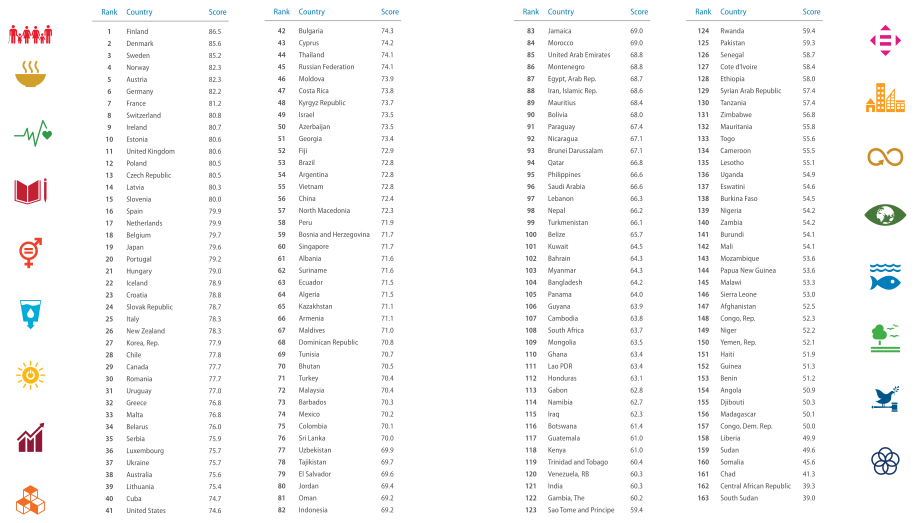
The 2022 SDG Index is topped by Finland, followed by three Nordic countries –Denmark, Sweden and Norway – and all top 10 countries are European countries. Yet even these countries face major challenges in achieving several SDGs. Overall, East and South Asia is the region that progressed most on the SDGs since their adoption in 2015. Bangladesh and Cambodia are the two countries that progressed most on the SDGs since 2015. By contrast Venezuela has declined the most on the SDG Index since their adoption in 2015.

A global plan to finance sustainable development is urgently needed.

Achieving the SDGs is fundamentally an investment agenda in physical infrastructure (including renewable energy, digital technologies) and human capital (including health, education). Yet the poorest half of the world lacks market access to capital on acceptable terms. Poor and vulnerable countries have been hit hard by the multiple crises and their spillovers. Rising budget pressures, increased military spending and major shifts in strategic priorities, especially in European countries, might squeeze development funds available to support sustainable development globally. In this context, the report presents a five‐point plan for financing the SDGs globally. It underlines the key role of the G20, International Monetary Fund (IMF) and Multilateral Development Banks (MDBs) to expand SDG financing globally.

At mid‐point on the way to 2030, policy efforts and commitments for the SDGs vary greatly.

At mid‐point on the way to 2030, the integration of the SDGs into policies, regulations, budgets, monitoring systems, and other government policies and procedures still varies greatly across countries. Among G20 member states, the United States, Brazil, and the Russian Federation exhibit the least support for the 2030 Agenda and the SDGs. By contrast, Nordic countries demonstrate relatively high support for the SDGs, as do Argentina, Germany, Japan and Mexico (all G20 countries). Some countries, such as Benin and Nigeria, for example, have large gaps in their SDG Index yet also earn relatively high scores for their policy efforts. Interestingly, Benin and Mexico have both issued SDG Sovereign Bonds in recent years to scale up their sustainable development investments.

For the second time since their adoption in 2015, UN Member States will meet in September 2023 on the side‐line of the UN general Assembly for the SDG Summit to define priorities for restoring and accelerating SDG progress by 2030 and beyond. Ambitious and sound national targets, strategies, and plans are crucial to turning the SDGs into an action agenda.

Other findings of the Sustainable Development Report 2022:

  • Rich countries generate negative international spillovers notably through unsustainable consumption. The 2022 international Spillover Index included in this report underlines how rich countries, generate negative socioeconomic and environmental spillovers, including through unsustainable trade and supply chains.
  • New partnerships and innovations that emerged during the COVID‐19 pandemic, including in scientific cooperation and data, should be scaled‐up to support the SDGs. Science, technological innovations, and data systems can help identify solutions in times of crises and can provide decisive contributions to address the major challenges of our times. These call for increased and prolonged investments in statistical capacities, R&D, and education and skills.

Since 2015, the SDR provides the most up‐to‐date data to track and rank the performance of all UN member states on the SDGs. The report was written by a group of independent experts at the Sustainable Development Solutions Network (SDSN), led by its President, Prof. Jeffrey Sachs. The report is produced by SDSN, published by Cambridge University Press, and co‐funded by Bertelsmann Stiftung.

2022 SDG Index ranking and score

Contacts

Guillaume Lafortune | guillaume.lafortune@unsdsn.org | +33 (0) 6 60 27 57 50
Vice President & Head of the Paris Office, Sustainable Development Solutions Network (SDSN)

Dr. Christian Kroll | c.kroll@alumni.lse.ac.uk
Co-Author of the report

Maëlle Voil | media@unsdsn.org | +33 (0) 6 99 41 70 11

About SDSN

The UN Sustainable Development Solutions Network (SDSN) mobilizes scientific and technical expertise from academia, civil society, and the private sector to support practical problem solving for sustainable development at local, national, and globalscales. The SDSN has been operating since 2012 under the auspices of the UN Secretary‐General. The SDSN is building national and regional networks of knowledge institutions, solution‐focused thematic networks, and the SDG Academy, an online university for sustainable development.

Green jobs for a bright future

CSR Europe is the leading European business network for Corporate Sustainability and Responsibility. Through its network of around 39 corporate members and 41 National CSR organizations, it gathers over 10,000 companies and acts as a platform for those businesses looking to enhance sustainable growth and positively contribute to society.

We interviewed Marco Matrisciano, Sustainability Manager for CSR Europe, in order to see how is he focusing on supporting companies across different industries in integrating ESG elements in strategy and investment decision. Marco is a sustainability professional and a foresight trainer with experience in business collaboration and design thinking. During the years, he successfully developed multi-stakeholder framework within business and academia linked to system change and sustainable development.

The interview was initially published in November 2021, in the bilingual yearbook Community Index Magazine no. 3, printed edition. It can be ordered here: https://communityindex.ro/community-index-magazine-2021/

1. Your goal at CSR Europe is mainstreaming sustainability. How do you scale up the impact of individual efforts made by companies, industry federations and EU leaders?

Mainstreaming sustainability starts with the projection of trends into different scenarios around diverse alternative futures where companies and sectors can have a better impact on society. EU leaders have the responsibility to enhance the convergence of the society towards a most plausible and sustainable scenario. I believe that supporting companies in their journey in integrating sustainability does not just mean working to minimize their impact on the planet as a business, but growing their ambition to play a leadership role in society by inspiring and implementing solutions to societal and environmental challenges.

To engage these stakeholders in practical, impact-oriented projects, I am responsible for corporate engagement in the CSR Europe’s Pact for Sustainable Industry, building partnerships with representatives from 40 different industry sectors and more than 200 European business associations. Securing the engagement of companies and associations begins with the assessment of their level of maturity and readiness of the sustainability strategy. The objective is to identify common pathways and priorities to explore inter or cross-sectorial collaboration.

2. If we particularly talk about sustainable practices in sports, would mainstreaming them increase the awareness of the broader public towards these issues?

Despite the growing awareness of the population, still a lot needs to be done to reach those who have zero or low knowledge of the principles of sustainability. Professional athletes and sporting organizations must lead by example, given the role they have in our society. We become fans of their gesture as children, and it cannot be ignored how important these role models are in influencing future generations. Last year, we have seen sports pitches becoming a global stage to deliver messages against racism and address social justice issues. Keeping the focus that much on the social component has grown also in ESG investing. Also, sport brands can finally benefit from more awareness in the society and support athletes ready to step up in order to move the conversation forward.

3. You are a target-oriented project manager, working in the sustainability field. While setting sustainability performance targets can be difficult, what are the best ways to be successful?

For measuring the impact on the environment, we can benefit from the work done by leading organization supporting companies and industry sector to design their strategy to achieve science-based targets. Meaning preventing climate change by limiting global warming to well-below 2°C.

For tackling social issues, the United Nation Sustainable Development Goals are providing targets and indicators to leave no one behind. We have all the tools to design potential pathways towards a more sustainable economy. Building sustainable scenarios is a good approach to start. It gives the opportunity to people and organizations to explore alternative futures by integrating concrete targets in their strategy. Especially, when exploring these scenarios help to identify with which group of stakeholders a company must engage in order to achieve its targets.

4. How can companies encourage their employees and business partners to show more genuine commitment to CSR?

By showing positive impact. If a company is committed, it should always seek innovative strategy and tactics to foster impactful change. But translating those strategies into actions require the collaboration of employees and business partners.

Engaging employees helps companies to create shared commitments. While regarding other stakeholders, implementing sustainable business models requires building partnership only with those partners who can contribute to strategy.

5. In what ways does sustainability mean new growth and job opportunities in Europe?

The debate around the impact on job creation of a transition towards a low carbon society started in Europe already across the years 2000’ with the transformation of the European energy sector. Since the Kyoto Protocol of 1997, there has been an increasing quantification of the employment effects of these policies. The launch of the European Green Deal with its ambitious targets and roadmap for Europe towards 2050 has been particularly supported by the potential number of jobs creation. Not just for the direct impact on a country or region, but for the spillover effect amplified by an increasingly globalized world.

The estimation around the industrial transformation of the next 20-25 years turns around the capacity of the Union to develop new technology and upskill or reskill the workforce. The economic transformation towards low carbon society that we are experiencing at a faster pace has an impact not only on the creation of jobs, but also on the development of a globally competitive industry based on technology shift and not labor costs. But as described also in a study of the European Commission on the “Paths towards a sustainable industry in 2035”, the development of “Green Industries” can create a large number of green jobs but also job loss and shift in those sectors, particularly carbon intensive.

The Community of Place becomes The Community of Purpose

The pandemic has given us an opportunity we would never have allowed ourselves to radically shake up the way that we see ourselves. Fundamental to this is the way that we identify ourselves in relation to each other. It has allowed us to look at our sense of community in a new way. For a long time, our communities have been defined by geography. Is now the time to revisit this definition and see whether we need be so constrained?

As we leave the current pandemic crisis, we can look back at what Jonathan Stubbs calls “the trial we never would have given ourselves” and a glimpse into the future of work. One of those is the change in our idea of community, and how we define those groups to which we identify. Ever since Martin Buber stated that “the place is community”, the concept of community (in terms of Gemeinschaft and Gesellschaft) has been strongly tied to geography.

The concept of Community of Place likely dates back to the creation of the nation state, where a sense of identity was forged based on a shared geographical location. Before, community was defined by Relationship, the people with whom you aligned yourself, your identity tied to family or allegiance. Now, identity was aligned with geography. For before a Roman citizen could be an inhabitant of any country in the Empire, a speaker of any of various languages, with one of many cultural identities. Now, to be English meant to identify home as England, to be Romanian meant Romania. This quickly translated into other aspects of life too. Work became somewhere that activity took place – a factory, an office – with others who went to the same place. School became a venue for education. Our definition of our community, and by extension, our identity, became tied to the place we were born, the place that we live, the place that we work.

However, over time, this definition has been challenged. Community of Relationship never truly went away, although much weakened, but other models have risen. Increasing globalisation and pervasive communication have broken down the solidarity of Place. Instead, during the 1980s, we began to realise that Communities of Time were as important, and the rise of shared spaces continues to challenge the Communities of Place. What the pandemic has done is accelerate this change. No longer do people throng to the office. Instead, we meet at the same time online, what Ryan Anderson calls distributed working. The transition has been difficult for many, not least because many organisations and teams have attempted to recreate the sense of Community of Place virtually at the same time as trying to hold onto a Community of Time. We have also realised that Communities of Time are in themselves insufficient. We need something more.

The solution, I suggest, is not to go back to relying on Time or Place for our sense of Community. Rather, it is to look beyond these constraints to what the purpose of the community is. Over the last few decades, we have seen to rise of business with a purpose. A way to look at organisations as more than the sum of parts, with objectives that go beyond the pragmatic, Community of Purpose provides a powerful alternative to Place, and, with increasing globalisation, forms an antidote to the greater risk that we would lose community altogether.

Business now has an opportunity to look at their communities and redefine them, and there are external factors that mean that Communities of Purpose are likely to come to dominate. Fundamental to this is the inexorable rise of responsible business. Whether it be the response of businesses like AstraZeneca and Diageo whose alignment with social value was critical to the quashing of the pandemic, or the environmental and social values evident in the AGMs of companies held in 2021 like Unilever, where 99.6% of shareholders backed a radical climate transition plan, it is clear that Purpose beyond Profit is now firmly at the driving seat of many businesses. As the awareness that this also has very positive financial, HR and other business benefits grows, it is likely that this will spread even wider.

However, the rate of change is also likely to increase as there are a lot of positive feedbacks that push the growth of a broader Community of Purpose. Some of this will be driven by technology. For example, the greater availability of VR and MR (virtual and mixed reality) is likely to remove even more geographical constraints in more sectors, including enabling greater collaboration in design, more immersive education and training and more inclusive access to roles. Some of it will come from employees, who, as Edelman reports, are requiring increasingly high levels of social responsibility from their companies. Some will also come from the rise of a Community of Purpose amongst customers, who respond to what Smith and Alcorn called cause marketing, who exhibit high levels of brand loyalty and are often very vocal on social media. This often overlaps with the growing Community of Purpose amongst investors, as ESG requirements become the minimum standard and the rise of more active investors looking to hold companies increasingly accountable.

One effect of this is that responsible business leadership will become even more important. Responsible business is fundamentally about the creation of purpose that transcends short term financial gains, and sustainable business leadership is essentially aligning corporate values with purpose. Right now, there is a clear competitive opportunity for companies to embed themselves as Communities of Purpose to their customers, employees and wider society. Those who succeed, I suggest will be the leading businesses of tomorrow.

Simon Graham is Head of Innovation of De Courcy Alexander, the London-based sustainable innovation consultancy. Recipient of over 20 awards for his business change programmes built around zero carbon, zero waste and zero human trafficking, he has seen how companies can be transformed by focusing on their purpose. He is now involved in transformational programmes which combine cutting edge technologies, new business models and focus on community cohesion, working with public and private sector partners in areas like blockchain and IoT.

Simon also advises businesses and government bodies on how to simultaneously achieve net zero and improve customer satisfaction. Widely quoted, from The Economist to New Scientist, his latest contribution, published by Palgrave Macmillan, was titled “Sustainability, Management Education, and Professions: A Practitioner Perspective”, looking at how universities can nurture a new generation of sustainable leaders.

Must-Have CRS skills for a bright future

From being a good influencer to efficient networking, the modern-day CRS professional needs a wide range of skills to be able to deliver a long-term vision and impactful change.

We discussed this topic with Anita Longley, a board level sustainability professional with over 25 years’ experience in the private and public sectors. She is currently Chair of the Institute of Corporate Responsibility and Sustainability (ICRS), a go-to platform for anyone who wants to fine tune their CRS knowledge, learn from other members and stay up to date with the latest sustainable thinking.

A passionate advocate for collaboration and transparency, she has delivered impactful sustainability strategies and community partnerships, and is a trustee of the ScottishPower Foundation.

1. You have delivered impactful sustainability programmes over time. What are the main elements of a successful programme?

A successful sustainability programme should be central to the purpose and strategy of an organization and it must be authentic. It should focus on what’s significant to the business and encompass environmental, social and governance (ESG) issues.

In order to create long lasting change, companies need to understand their purpose and the impact of their activities – they have to strive towards ‘net positive’. It’s no longer enough just to use a risk-based approach, because opportunities will be missed. Corporate Responsibility is about helping companies positively engage in the process of shaping our shared future.

Leading companies set bold targets and report their progress regularly. The strategy is led by the Board, informed by effective stakeholder engagement and delivered through collaborative action. The increasing focus on ESG from the financial sector is helping to drive this change and support business resilience, as we have seen during the global pandemic.

Investors are now aiming to double their sustainable investments over the next five years.

2. The modern-day CRS professionals intend to create visible change in the company, but to do so they must gain the support of multiple decision-makers in order to make it happen. What approach would you recommend in this regard?

The first step is to set a vision that reflects the purpose of the organization and secure ‘buy in’ to that vision. Ultimately, businesses can only make progress in their ESG strategies if they convince the financial markets that they are worth the investment. This means that ESG must be a core part of board discussions.

Building capacity and understanding of the sustainability within the company will ensure effective decision making. This can be supported by integrating ESG into existing business processes, such as risk management or financial approval mechanisms.

We’ve seen a sea change in attitudes towards sustainability and the role of business. Employees can be the best advocates for change, and their interest and enthusiasm should be embraced. Employee volunteering, for example, provides opportunities to develop understanding and ensure practical support. Engaging senior managers with stakeholders, such as vulnerable customers, really helps them understand the challenges that those customers face, and how they can best be supported.

In order to influence, we need to understand what motivates people, how the business operates and when and how decisions are made. It will be different for everyone and each organization, and there’s a balance to be had between challenging and supporting. Professionals must be clear about the business benefits and offer solutions, not problems.

3. Which do you consider to be the must-have skills for a CRS professional? Which ones can be taught in time?

Now, we have an extraordinary opportunity to embed sustainability in business, and professionals have a key role to play. The Institute of Corporate Responsibility and Sustainability has developed a comprehensive framework of core competencies and guiding principles for corporate responsibility professionals. We use this framework to appoint our fellows and support individual personal development.

These include knowledge-based skills – ranging, for example, from environment to ethics and a range of ‘soft skills’, such as influencing. Professionals must develop and deliver impactful and measurable strategy, engage stakeholders effectively, work collaboratively and have strong communication skills. Corporate responsibility practitioners are in a position of trust and need to act with integrity to uphold that trust.

The sustainability profession is evolving very quickly and specialists need to understand a wide range of issues, so networking is extremely important. CRS professionals are good at sharing the best and the constantly evolving practices, we found this was particularly important during the early phase of the pandemic. Mentoring also provides an opportunity to test and develop new skills.

4. What courses, certifications or learning platforms would you recommend to any CSR aficionado?

My ‘go to’ learning platform is, of course, the Institute of Corporate Responsibility and Sustainability (www.icrs.info), which was established to support CRS professionals to be brilliant at what they do. We provide networking, practitioner led webinars, resources, mentoring and a competency framework. I would also recommend the Cambridge Institute for Sustainability Leadership, which offers a range of courses.

Sustainable Creativity: a pillar for self-growth

Rod Judkins is an artist and writer who lectures on creative methods and processes at one of the world’s foremost art colleges – Central Saint Martins College of Art. It is one of the world’s pre-eminent art schools whose alumni – ranging from artists like Lucian Freud, Stella McCartney, Sarah Burton and Alexander McQueen – have helped shape our culture. Rod is also a figurative artist who trained at the Royal College of Art in London and has had numerous one-man exhibitions at Tate Britain, The National Portrait Gallery, and Royal Academy.

As an artist, he encountered many creative thinkers in London’s art world. In his books, “The Art of Creative Thinking” and “Make Brilliant Work” he sets down some of the lessons that can be learned from the creative methods of famous artists and thinkers.

1.Your book, “The Art of Creative Thinking”, offers a profound understanding of human creativity through inspirational stories about famous artists, entrepreneurs, and other creative thinkers. How can those stories provoke readers to embark in their own creative journey?

The motivation to write “The Art of Creative Thinking” was to help my students at Central Saint Martins discover their creative journey. Every chapter explains a method that allows people to be more creative. For instance, in the chapter “Feel Inadequate”, I address how we all feel that we are not talented enough. I used the example of when I was a student at the Royal College of Art, and David Bowie visited to look at our work. We were all struck by his lack of confidence in himself, but his self-doubt was part of his driving force to prove himself.

I also told the story of Todd McFarlane who worked for Marvel Comics. They asked him to make his drawings less shocking, so he quit and, despite his self-doubt, started his own company and became a huge success. We all suffer from self-doubt, but we have to find a way to overcome it.

2.You consider creativity “a way of relating to your life: it is about creating yourself, creating a better future, and taking the opportunities that you are currently missing”. Should we be talking about sustainable creativity or creative sustainability? Or both? ”

I come at it from the angle of sustainable creativity. I think the creatives are sensitive people, and sustainability is about being sensitive to our environment. To achieve long-term sustainability, we must push towards a green economy and find creative solutions. Creativity and sustainability are inseparable.

In my new book, “Make Brilliant Work: How to Unlock Your Creativity and Succeed”, I use the example of how a firm of Italian architects responded to a competition to design a bridge. They created a power station – with a bridge attached. The “Solar Wind” bridge had twenty-six wind turbines added to the structure and solar cells embedded in the roadway and could generate enough renewable energy to power thousands of homes. They went the extra mile and solved more than the problem of crossing from one side to the other. My point was: don’t see your goal as fulfilling the client’s brief; see your goal as producing something extraordinary.

If your work is ordinary, there’s a solution: add “extra” to ordinary. Maybe you feel you are an ordinary person doing an ordinary job in an ordinary way. Decide to do something “extra”, and you’re on your way to becoming “extra” ordinary. “Extra” is from the Latin, meaning “beyond, better than the ordinary”. It’s not enough to fulfil the brief. Be generous. Go above and beyond what’s expected of you.

3.“Make freedom a career” is one of your most powerful urges. Creativity requires dedication as well as mental liberation, but sometimes one can feel stuck. What is your advice for those who feel lost and are not able to see their inner creative spark?

Let me tell you the story of Hergé, the creator of the Tintin books, and his creative block. He didn’t produce anything for months and had nightmares due to the blank page syndrome. He went to see a psychiatrist who advised him to kill off Tintin and retire because work was destroying his mental health.

Hergé ignored the psychiatrist’s advice. He decided creativity was the solution, not the problem. He wrote about his creative block. Tintin in Tibet is about Tintin lost in the snowy white Himalayas looking for a friend. It’s a metaphor for Hergé being lost and searching for a solution. I tried to show that overcoming creative block is about asking yourself what you care about most and using that as your subject matter.

4.In another book you wrote, you consider ideas “our only currency”. It is interesting to see ourselves as ideas juke boxes, but, actually, implementing those ideas should be the bold response to this volatile world we currently live in. How can we make sure our ideas do not go to die?

The point of my book “Ideas Are Your Only Currency” is to help every reader become an “ideas person”. At Central Saint Martins, we don’t try to produce a graphic designer, sculptor, or fashion designer. We try to create an “ideas person” who is comfortable thinking up lots of ideas and then chooses the best one. If it isn’t successful, we help them rapidly to think of another one.

5.Creativity should be seen as a pillar of sustainable development, as it is vital for our lives and our planet. What is the future that this combination unlocks? How do you think the world is going to heal and recover?

I agree that creativity is the pillar of sustainable development. In “Make Brilliant Work”, I use the example of a beautiful building called “The Egg” in Mumbai. Architect James Law created a planet – a significant, inspiring construction. It’s a building with a self-contained, sustainable, natural ecosystem like a planet, where high levels of natural light create low-energy demand. At the same time, solar-energy panels and wind turbines generate electricity.

It’s a self-contained, mini-world delivering an enjoyable environment in which to live and work. The latest technology enables “The Egg” to be aware of the heating and lighting and adapt it as necessary: it’s a “smart” building, a conscious entity. It’s a building you can fall in love with, feel a deep emotional attachment to, because it’s more than just a structure: it’s an idea.

I use it as an example of how a great idea holds your project together and keeps it driving forwards. It’s an engine to power your way through the inevitable problems you’ll encounter.

6.In what striking ways do you think the pandemic changed the business of ideas? Which top three lessons did you learn in 2020?

The first lesson would be to get people to help you. I wrote the last chapters of “Make Brilliant Work” when the pandemic struck, and some of the chapters reflect on the changing business environment. In the chapter, “Help People to Help You”, I use Robert Altman, one of the greatest and most influential film directors of his generation, as an example of how you need to get people to help you. As a director, he was the team leader and inspired loyalty. He gave his crew freedom and urged them to fulfil their potential. He was the cement that held a team together, and he became the director everyone wanted to work with. You can’t produce brilliant work without help from others. It’s counterintuitive, but the more generous you are, the more people give you. The second lesson would be from the chapter, ‚Disrupt or be Disrupted.’ The speed of change makes nonsense of strategic planning. Sudden developments in technology create uncertainty, causing anxiety. Unexpected events disrupt your routines, and confusing new ideas appear almost daily. But there’s a way of dealing with and prospering from the chaos. Embrace it and use it to your advantage.

The third lesson would be from the chapter “Which Class of Person Are You?”. Leonardo da Vinci said: “There are three classes of people: those who see, those who see when they are shown, those who do not see”. Our task is to become “those who see” and notice the possibilities around us. We are all born into the “those who do not see” group but can elevate ourselves to the “see when they are shown” group with education. We have our eyes open, but our minds shut, and we never “see” what is around us. We must join “those who see” and be alert and aware of the value (and I don’t mean monetary value) of our surroundings.

The interview was initially published in November 2021, in the bilingual yearbook Community Index Magazine no. 3, printed edition. It can be ordered here: https://communityindex.ro/community-index-magazine-2021/