New SDSN Report: Global Plan to Finance the UN Sustainable Development Goals Urgently Needed

Paris, 02 June 2022 – The Sustainable Development Report (SDR), including the SDG Index and Dashboards which track progress on the Sustainable Development Goals (SDGs), was released. The report shows that multiple and simultaneous international crises have halted progress on the universal goals adopted by all UN member countries during the historic 2015 summit.

“Fifty years after the first UN Conference on the human environment in Stockholm in 1972, the bedrock SDG principles of social inclusion, clean energy, responsible consumption, and universal access to public services are needed more than ever to respond to the major challenges of our time. Poor and vulnerable countries are being hit particularly hard by multiple health, geopolitical and climate crises and their spillovers. To restore and accelerate SDG progress, we need global cooperation to end the pandemic, negotiate an end to the war in Ukraine, and secure the financing needed to achieve the SDGs.”, says Jeffrey D. Sachs, President of the SDSN and first author of the report.

Full report:
Sachs, J., Lafortune, G., Kroll, C., Fuller, G., Woelm, F. (2022). From Crisis to Sustainable Development: the SDGs as Roadmap to 2030 and Beyond. Sustainable Development Report 2022. Cambridge: Cambridge University Press.
The report can be downloaded for free here:
Website: https://www.sdgindex.org/
Data visualization: https://dashboards.sdgindex.org/

For the second year in a row, the world is no longer making progress on the SDGs.

Multiple and simultaneous health, climate, biodiversity, geopolitical and military crises are major setbacks for sustainable development globally. The SDG Index world average has slightly decreased in 2021 for the second year in a row, largely due to the impact of the pandemic on SDG1 (No Poverty) and SDG8 (Decent Work and Economic Growth) and poor performance on SDG11‐15 (climate, biodiversity, and sustainable urban development goals). Besides their massive humanitarian costs, military conflicts – including the war in Ukraine – have major international spillovers on food security and energy prices, which are amplified by the climate and biodiversity crises. They also crowd out space for long‐term thinking and investments. Peace, diplomacy, and international cooperation are fundamental conditions for the world to progress on the SDGs towards 2030 and beyond.

The 2022 SDG Index is topped by Finland, followed by three Nordic countries –Denmark, Sweden and Norway – and all top 10 countries are European countries. Yet even these countries face major challenges in achieving several SDGs. Overall, East and South Asia is the region that progressed most on the SDGs since their adoption in 2015. Bangladesh and Cambodia are the two countries that progressed most on the SDGs since 2015. By contrast Venezuela has declined the most on the SDG Index since their adoption in 2015.

A global plan to finance sustainable development is urgently needed.

Achieving the SDGs is fundamentally an investment agenda in physical infrastructure (including renewable energy, digital technologies) and human capital (including health, education). Yet the poorest half of the world lacks market access to capital on acceptable terms. Poor and vulnerable countries have been hit hard by the multiple crises and their spillovers. Rising budget pressures, increased military spending and major shifts in strategic priorities, especially in European countries, might squeeze development funds available to support sustainable development globally. In this context, the report presents a five‐point plan for financing the SDGs globally. It underlines the key role of the G20, International Monetary Fund (IMF) and Multilateral Development Banks (MDBs) to expand SDG financing globally.

At mid‐point on the way to 2030, policy efforts and commitments for the SDGs vary greatly.

At mid‐point on the way to 2030, the integration of the SDGs into policies, regulations, budgets, monitoring systems, and other government policies and procedures still varies greatly across countries. Among G20 member states, the United States, Brazil, and the Russian Federation exhibit the least support for the 2030 Agenda and the SDGs. By contrast, Nordic countries demonstrate relatively high support for the SDGs, as do Argentina, Germany, Japan and Mexico (all G20 countries). Some countries, such as Benin and Nigeria, for example, have large gaps in their SDG Index yet also earn relatively high scores for their policy efforts. Interestingly, Benin and Mexico have both issued SDG Sovereign Bonds in recent years to scale up their sustainable development investments.

For the second time since their adoption in 2015, UN Member States will meet in September 2023 on the side‐line of the UN general Assembly for the SDG Summit to define priorities for restoring and accelerating SDG progress by 2030 and beyond. Ambitious and sound national targets, strategies, and plans are crucial to turning the SDGs into an action agenda.

Other findings of the Sustainable Development Report 2022:

  • Rich countries generate negative international spillovers notably through unsustainable consumption. The 2022 international Spillover Index included in this report underlines how rich countries, generate negative socioeconomic and environmental spillovers, including through unsustainable trade and supply chains.
  • New partnerships and innovations that emerged during the COVID‐19 pandemic, including in scientific cooperation and data, should be scaled‐up to support the SDGs. Science, technological innovations, and data systems can help identify solutions in times of crises and can provide decisive contributions to address the major challenges of our times. These call for increased and prolonged investments in statistical capacities, R&D, and education and skills.

Since 2015, the SDR provides the most up‐to‐date data to track and rank the performance of all UN member states on the SDGs. The report was written by a group of independent experts at the Sustainable Development Solutions Network (SDSN), led by its President, Prof. Jeffrey Sachs. The report is produced by SDSN, published by Cambridge University Press, and co‐funded by Bertelsmann Stiftung.
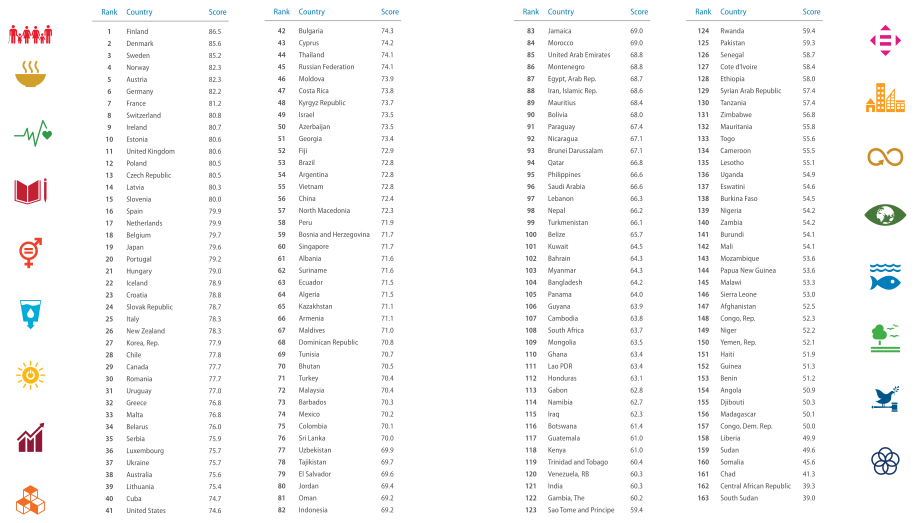
2022 SDG Index ranking and score

Contacts

Guillaume Lafortune | guillaume.lafortune@unsdsn.org | +33 (0) 6 60 27 57 50
Vice President & Head of the Paris Office, Sustainable Development Solutions Network (SDSN)

Dr. Christian Kroll | c.kroll@alumni.lse.ac.uk
Co-Author of the report

Maëlle Voil | media@unsdsn.org | +33 (0) 6 99 41 70 11

About SDSN

The UN Sustainable Development Solutions Network (SDSN) mobilizes scientific and technical expertise from academia, civil society, and the private sector to support practical problem solving for sustainable development at local, national, and globalscales. The SDSN has been operating since 2012 under the auspices of the UN Secretary‐General. The SDSN is building national and regional networks of knowledge institutions, solution‐focused thematic networks, and the SDG Academy, an online university for sustainable development.

2021 EUROPE SUSTAINABLE DEVELOPMENT REPORT

New report by SDSN and IEEP shows significant international environmental and social spillovers generated by consumption of goods and service in the EU that must be addressed to achieve the Sustainable Development Goals


Paris, 14 December 2021 – The Sustainable Development Solutions Network (SDSN), SDSN Europe and the Institute for
European Environmental Policy (IEEP) publish today the third edition of the Europe Sustainable Development Report 2021, an independent quantitative report on the progress of the European Union (EU), its member states, and other European countries towards the Sustainable Development Goals (SDGs), agreed by all UN member states in 2015.


The Europe Sustainable Development Report 2021 is part of the broader Sustainable Development Report (SDR) series which tracks the performance of countries and municipalities around the world on the SDGs since 2015. It builds on a peer-reviewed and statistically audited methodology, and includes country profiles for the EU, its member states and European partner countries, including for the first time this year EU candidate countries (Albania, the Republic of North Macedonia, Montenegro, Serbia and Turkey) as well as Bosnia and Herzegovina. This year’s edition includes chapters on “The European Green Deal, EU Recovery and the SDGs” and on “Transforming Food and Land systems to achieve the SDGs”.


The report comes out at a time when cases of COVID-19 are soaring again in Europe and the emergence of new variants make the health situation and economic recovery uncertain. Ending the COVID-19 pandemic everywhere is a prerequisite for restoring and accelerating SDG progress in Europe and globally. As emphasized under SDG17 (Partnerships for the Goals), Europe should continue to work with the United Nations, G20, G7 and other key partners to accelerate the roll out of vaccines everywhere, mobilize financial resources and address the lack of fiscal space to finance emergency expenditures and recovery plans in low and middle-income countries.


Guillaume Lafortune, Vice President of the SDSN and lead author of the report, states that:


“The COVID-19 pandemic is a setback for sustainable development in the EU and in the rest of the world. Yet strong
automatic stabilizers and deliberate policies to protect the economy and people helped mitigate SDG impacts from
COVID-19 in the EU compared with most other world regions. Ending the COVID-19 pandemic everywhere is the
number one priority to restore SDG progress in the EU and globally. The SDGs and the Paris Agreement reflect Europe’s
values and should remain the guidepost for domestic EU policies and international action.”


Ahead of the 2023 United-Nations SDG Summit, the EU must advance long-term development objectives and play a leadership role internationally in restoring SDG progress. Adolf Kloke-Lesch, Co-Chair of SDSN Europe and a co-author of the report, underlines:


“The EU has legislative and policy tools in place, or in preparation, to address most SDG challenges but still lacks clarity
on how it plans to achieve the SDGs. An integrated approach to the SDGs must focus on three broad areas: internal
priorities (including the implementation of the European Green Deal), diplomacy and development cooperation and
lastly international spillovers which can undermine other countries’ ability to achieve the SDGs. The EU must lead
multilateral Green Deal and SDG Diplomacy, including with China and Africa.”


Citation details: Lafortune, G., Cortés Puch, M., Mosnier, A., Fuller, G., Diaz, M., Riccaboni, A., Kloke-Lesch, A., Zachariadis, T., Carli, E. Oger, A., (2021). Europe Sustainable Development Report 2021: Transforming the European Union to achieve the Sustainable Development Goals. SDSN, SDSN Europe and IEEP. France: Paris.
Download the report and access the data (online from 14 December 2021):
Website: https://www.sdgindex.org/esdr2021
Data visualization: https://eu-dashboards.sdgindex.org/


The COVID-19 pandemic – a setback for the Sustainable Development Goals but the SDGs should remain the guidepost in the EU and internationally


For the first time since the adoption of the SDGs in 2015, the average SDG Index score of the EU did not increase in 2020 — in fact it slightly declined in the EU27 on average mainly because of its negative impact on life expectancy, poverty and unemployment. Despite calls to scale-back SDG ambitions and geopolitical tensions, the SDGs remain the only integrated framework for economic, social and environmental development adopted by all UN Member States.


The SDG Index across the EU27 countries has declined slightly in 2020 for the first time since the adoption of the SDGs in 2015 due to COVID-19


Note: SDG Index scores from 0 “worst” to 100 “best”. See detailed methodology and figure notes in the report. Source: Lafortune et al, 2021.


Europe faces its greatest SDG challenges in the areas of sustainable diets and agriculture, climate and biodiversity (SDG2, 12-15), in strengthening the convergence of living standards across its countries and regions and needs to accelerate progress on many goals. Finland tops the 2021 SDG Index for European countries (and worldwide) as it was less affected by the COVID-19 pandemic than most other EU countries. It is followed by two countries also from Northern Europe – Sweden and Denmark.


EU Candidate Countries perform well below the EU average but were making progress before the pandemic hit. The SDGs provide a useful framework for constructive dialogue and exchanges between the EU and Candidate Countries in the Western Balkans.


To ensure international legitimacy, the EU must address negative international spillovers


The consumption of goods and services in the EU leads to deforestation and environmental impacts abroad. Tolerance for poor labor standards in international supply chains can harm the poor, particularly women, in many developing countries. We estimate, for instance, that imports of textile products into the EU are related to 375 fatal workplace accidents (and 21,000 non-fatal accidents) every year in the world.
Through imports, for instance of cement and steel – Europe generates CO2 emissions in other parts of the world, including Africa, the Asia-Pacific and Latin America. While domestic CO2 emissions have been decreasing in the EU for many years, CO2 emissions emitted abroad to satisfy EU consumption (so called imported CO2 emissions) have increased in 2018, at a faster rate than GDP.


The proposal for a carbon-border-adjustment mechanism (CBAM), and other adjustment mechanisms and mirror clauses, and the new Due Diligence Regulation may help address and monitor carbon leakages and other adverse impacts embodied into unsustainable supply chains. Yet, they should be accompanied by increased technical cooperation and financial support to accelerate SDG progress in producing countries, including developing countries, to avoid the “protectionist” trap. The EU also needs to systematically track such spillovers at the Union, Member States and industry level and assess the impact of European policies on other countries and the Global Commons.


CO2 emissions generated abroad to satisfy EU’s consumption of goods and services grow faster than GDP


Note: Imported CO2 emissions refer to CO2 emissions emitted abroad (e.g. to produce cement or steel) to satisfy EU27 consumption of goods and services. Three-years moving averages. Source: Authors. Based on Eurostat (2021), IE-LAB and World Bank.


Four actions to strengthen the EU’s leadership ahead of the 2023 UN SDG Summit


The report makes practical recommendations to the EU leadership in order to strengthen SDG implementation and reporting and send a strong message to the international community on EU’s commitment to achieve the SDGs in the face of the COVID-19 pandemic:

  1. Publish a joint political statement issued by the three pillars of EU governance – European Council, the European
    Parliament, and the European Commission – reaffirming their strong commitment to the 2030 Agenda in response to the COVID 19 pandemic and its aftermath, and commitment to renewed momentum towards achieving the SDGs.
  2. Prepare a Communication issued by the European Commission clarifying how the EU aims to achieve the SDGs
    including targets, timelines and roadmaps. This Communication could be updated regularly. It could also show where existing policies need to become more ambitious and where additional policies are required.
  3. Set up a new mechanism or renew the mandate of the Multi-Stakeholder Platform for a structured engagement with civil society and scientists on SDG policies and monitoring.
  4. Prepare an EU-wide Voluntary National Review ahead of the SDG Summit in September 2023 at the United Nations covering internal priorities as well as diplomacy, and international actions to restore and protect the Global Commons and address international spillovers.
    Other findings:
    ● The updated Leave No One Behind Index for European countries tracks inequalities within countries – in income, access to services and opportunities. Countries that top the SDG Index also top the Leave No One Behind Index, indicating that sustainable development and the reduction of inequalities are mutually reinforcing goals.
    ● Further efforts are needed to strengthen the convergence of living standards across European countries. SDG9
    (Industry, Innovation and Infrastructure) is the goal with the largest spread in performance in Europe, with many
    European countries performing very well (“green” dashboard) but also many performing very poorly (“red”
    dashboard).
    ● The Multiannual Financial Framework, NextGenEU and Recovery and Resilience Facility provide financial firepower to accelerate the transformation of the EU over the period 2021-2027. Yet the guidelines provided to Member States to prepare their National Recovery and Resilience Plans did not include any references to the SDGs. An important challenge will be to ensure that the sum of national recovery plans adds up to coherent and ambitious EU-wide SDG transformations, including transformation of energy and food/land systems.
    ● In a context where Member States will have higher autonomy to decide on eligible activities under the new Common Agricultural Policy without mandatory targets and clear performance evaluation criteria, there is a high risk that national efforts will not be ambitious enough to jointly deliver the EU climate and biodiversity objectives. While Farm-to-Fork is the first holistic strategy of the food system, clear quantitative targets are missing to track progress from the processing and consumption side.

About SDSN
The UN Sustainable Development Solutions Network (SDSN) mobilizes scientific and technical expertise from academia, civil society, and the private sector to support practical problem solving for sustainable development at local, national, and global scales. The SDSN has been operating since 2012 under the auspices of the UN Secretary-General. The SDSN is building national and regional networks of knowledge institutions, solution-focused thematic networks, and the SDG Academy, an online university for sustainable development.

About SDSN Europe
Set up in 2020, SDSN Europe mobilizes and coordinates the knowledge and science across SDSN networks in support of a sustainable and resilient European Recovery. With ten national and regional networks of universities and knowledge institutions in the EU, and over 360 member organizations across the entire continent, SDSN is ideally placed to provide evidence-based policy development in Europe.

About IEEP
The Institute for European Environmental Policy (IEEP) is a sustainability think tank with main offices in Brussels. Working with stakeholders across EU institutions, international bodies, academia, civil society and industry, our team of policy professionals composed of economists, scientists and lawyers produce evidence-based research and policy insight. Our work spans nine research areas and covers both short term policy issues and long-term strategic studies. As a not-for-profit organization with over 40-years of experience, we are committed to advancing impact-driven sustainability policy across the EU and the world.

Contact
For further information or to organize an interview please contact:
Maëlle Voil
Communication Manager Paris, SDSN
maelle.voil@unsdsn.org
+33 6 99 41 70 11