Climate Neutral and Net Zero Come Under Intense Scrutiny from EU Lawmakers

What do the “climate neutral” and “net zero” claims mean and when can companies use them?

Author: Maria-Antoanela Ioniță – Sustainability Communications Specialist

As we continue to explore the depths of corporate sustainability communications (check our guide to avoid greenwashing at the shelf here), we make another step at two of the most criticized, yet widely used claims: net zero and climate neutral.

They are, in fact, similar – one includes the other. Net zero refers to the result of avoiding the production of greenhouse gas emissions and then removing the ones that get produced, for which different methods are available. Climate neutrality takes several steps forward and refers to reducing all GHG to zero while eliminating all other negative environmental impacts produced by the company.


Both targets are ambitious, much like the European Climate Law they aim to align companies with. After all, EU member states are required to achieve a net reduction of greenhouse gas emissions by at least 55% by 2030 compared to 1990 levels. Yet recent moves by regulators show that these claims have become obsolete.

While the European Commission formalized the climate-neutral Europe ambition in the Green Deal agenda, they have recently started to place more scrutiny on sustainability communications that can lead to greenwashing. As such, the European Parliament has voted in favour of banning the use of the climate neutrality claim in the absence of substantial evidence.

The problems with the net zero and climate neutral claims

Both net zero and climate neutral claims have been enthusiastically embraced by companies who want to be at the forefront of sustainability action to define their climate ambitions. Having ambitious sustainability goals can boost investor confidence, increase brand reputation and consumer loyalty, and show compliance with regulations.

The big issue is the lack of accountability for these pledges, which arises from previously missing EU-wide regulation and guidance on such claims. We got to the point where two-thirds of the global economy has net zero targets. But how many have clear strategies, plans, and intermediary steps? Only 5%, according to a study. Left unguided and unsupervised, companies fumble in the dark for ways to signal their commitments without being restrained by timelines and methods.

The other issue that arises from the emissions-related pledges, in particular, is the extent to which it allows companies to rely on offsets. Carbon offsets or credits are instruments that companies can buy to compensate for the carbon emissions they generate.

What often happens with carbon offsets in practice, as documented by journalists and NGOs, is vastly different from what’s agreed on paper. Forests that have never been planted or trees that haven’t been monitored and died, conservation programs that never took place, and many other activities whose results haven’t been shared. Such practices have gradually eroded trust in offsetting practices. Moreover, experts argue offsets can divert companies’ attention from directly reducing carbon emissions in their operations and supply chains.

All this has brought carbon offsetting schemes under intense scrutiny. European lawmakers recently voted to ban carbon neutrality claims solely based on carbon offset schemes without reducing CO2 emissions generated by the company across its operations and supply chain.

Finally, an important issue stems from how climate neutrality, net zero, and other environmental claims are communicated to customers. As mentioned before, EU lawmakers are eyeing greenwashing attempts and consumer protection with their latest regulations. Not only are they banning the use of climate neutrality and other absolute claims without detailed evidence, but they also require more transparency and clarity in communications, such as explaining whether they refer to the entire company, a product, or a portion of a product.

Photo credit: Canva.com

A 3-Step Guide to Spotting Greenwashing for Consumers

How to make sure you are not tricked when you are trying to make a better choice.

Author: Maria-Antoanela Ioniță – Sustainability Communications Specialist

You go shopping. Enter the store, turn left, and head to the aisle with your desired products. You start reviewing the available selection and remember that you were planning to cut your environmental footprint. You give yourself a nudge to make a slightly better choice. Several brands boast the term eco-friendly, others shout green, and others still claim they are nature’s friend. You also see some recycled material percentages on certain labels. How do you choose?

You are excused from not having a straightforward recipe. The information regarding the sustainability of products available to consumers at the shelf is often vague, scarce, and misleading. Brands have the difficult task of balancing transparency and engaging language, scientific terminology and user-friendly explanations, detailed info and limited space. Upcoming regulations attempt to bring more guidance and rules, and thus clarity and transparency.

Yet, we still have plenty of methods available to distinguish genuine claims from greenwashing claims and thus choose the product that best matches our intent. Once you clarify this intent, you can start a quick evaluation of the product with only the information you have available at the shelf: the claims and labels, the ingredients and materials, and the competitors’ offerings.

Start from your intention

First, if you can, it’s good practice to clarify what environmental feature of a product is most important to you. In that specific product category and industry, is the packaging material a big problem? Or is it the way the product is manufactured in the supply chain? Can the product come from unsustainable sources or materials?

Usually, you’d expect manufacturers to have already considered the most important issues when improving the environmental footprint of their products, but that’s not always the case.

Then again, it is also a matter of the issues we mostly care about as consumers. We are not used to thinking in carbon emission equivalents, and some experts don’t even think we should. Certain people may be more concerned with plastic pollution, while others find animal farming unacceptable. And it’s alright to pick our battles.

3 steps to spot greenwashing

Greenwashing is a practice whereby organizations convey an incorrect impression or misleading information about their products and/or activities. It happens when companies try to emphasize a sustainable aspect of their product without giving the whole context or being accurate and transparent. Here is how you can stay away from greenwashed products when shopping.

1. Check the claims and labels

Sure, you’ve just read a catch slogan, and it made you feel better about that potential product. But how do you know whether there is any substance behind the claim? Here are three red flags to consider as you closely examine the product:

  • Does it use vague or ambiguous language? Beware of terms like “natural,” “eco-friendly,” or “green” without certifications and specific explanations. Genuine eco-conscious products should provide detailed information about their sustainable attributes: reducing emissions, offering 100% or predominantly natural ingredients and no toxic ones, replacing previously unrecyclable materials with recyclable ones, reducing packaging, and so on.
  • Does it lack (credible) certifications? See if the product displays any eco-labels and if these sound familiar to you. Authoritative certifications include Organic, Better Cotton Initiative, Cradle to Cradle Certified, Fair Trade, or Forest Stewardship Council (FSC). A certified product is preferred because it has already undergone third-party verifications that ensure (in theory) that the product has met specific environmental standards.
  • Do claims sound unrealistic or exaggerated? If the product promises extraordinary environmental benefits or absolute claims (100% sustainable) without providing any evidence or even contradicting itself elsewhere, put it down. While remarkable results are possible, companies should sustantiate them with proof; otherwise, sustainability is (currently) a journey with intermediary milestones.

2. Check materials and ingredients

Checking the ingredients and materials used in the making of a product and its packaging is a great way to verify claims made in the messaging.

One thing to look for is transparency. Are brands being transparent about their supply chains and manufacturing processes? Do they mention the different supply sources, materials, and production methods involved? The less information is available, the less trustworthy an environmental claim becomes.

If the company discloses a material as eco-friendly, they should accompany the claim with explanations. For instance, if the tag says biodegradable, it should further explain that it can degrade naturally in soil or water, over a certain period. If the product is marketed as “biodegradable”, but then it adds “industrially compostable”, the tag is misleading. You shouldn’t throw away the product with organic foods.

If you come across unfamiliar terms in the ingredient and material lists, it’s better to do a quick online research: after all, you’d better know what you put in your stomach or on your sink and how it can affect you. Greenwashing may involve masking harmful substances behind eco-friendly-sounding names.

3. Check competitors’ products

If you are not convinced, take a closer look at two or three brand offerings. Compare the claims and the way they disclose information. The more information you have available, the more you can understand what is the industry norm, and, thus, how to judge an environmental claim.

Bonus: Check the company’s track record

In time, you should become accustomed to some big brand names’ track records, from news, reports, and independent rankings and assessments. This will be highly useful when you try to determine the credibility and commitment of the company.

The future looks brighter for consumers, with QR codes, blockchain traceability, and other innovations promising a quick overview of a company’s overall value chain impact – directly at the shelf. For now, we must take a few extra steps as we navigate the mined field of sustainability claims.

Photo credit: Canva.com

What’s Inside the New Green Claims Directive and How It Fights Greenwashing

The EU recently unveiled an ambitious Green Claims Directive to protect consumers.

Author: Maria-Antoanela Ioniță – Sustainability Communications Specialist

To address surging greenwashing concerns and protect consumers, as well as the green transition agenda, the European Commission recently proposed the Green Claims Directive.

The claim would apply to most EU-based organizations that voluntarily make environmental claims, except for microenterprises (under ten employees and with a turnover lower than 2 million euros) and financial services companies with separate rules.

To meet the new rules described below, companies will likely need a robust sustainability communications strategy and data management. This may require additional resources, new capabilities and technologies, and operating model and team structure changes. However, companies will likely benefit from more robust sustainability communications by preventing reputational and litigation risks and increasing customer trust and loyalty.

Greenwashing is a fast way to erode trust

Around the world, more than half (60 per cent) of citizens say they do not trust climate communication, according to the 2022 Edelman Trust Barometer. The growing amount of greenwashing signalled by communication regulators, activists, and consumers may be at play. The EU identified that 53% of green claims “give vague, misleading, or unfounded information” and that 50% of green labels “offer weak or non-existent verification”.

Greenwashing refers to communications falsely portraying a company’s products, services, and projects as environmentally friendly to reap benefits from this positioning in the market. It can take various forms, depending on the communication means.

In addition to previous measures under the Unfair Commercial Practices Directive, the new proposal adds four new practices associated with greenwashing:

  • Using a sustainability label that is not based on a certification scheme or not established by public authorities;
  • Making a generic environmental claim without demonstrating recognized excellent environmental performance relevant to the claim;
  • Extending the environmental claim to the entire product if it concerns only a particular aspect of the product;
  • Presenting requirements imposed by law as a distinctive feature of the organization’s offer.

Greenwashing is a lose-lose-lose tactic. By confusing and eroding trust with consumers, as well as facing upcoming regulatory charges, greenwashing can ultimately damage organizations. In addition, it diminishes the efforts of consumers to make more responsible decisions towards the environment. Finally, it sabotages investors’ attempts to support, fund, and participate in the long-term success of more sustainable companies.

As a note, the reverse is also true. When they do not communicate sustainability efforts at all due to a fear of repercussions, organizations are engaging in greenwashing. In turn, greenwashing risks reducing the information available for consumers and investors to pinpoint sustainable products and companies.

Companies should still communicate sustainability efforts, regardless of their point in the journey – but they need to follow some steps:

  • Know their audiences well;
  • Pressure test with third parties to ensure that both storytelling and technical elements are meaningful;
  • Make sure claims are transparent, science-based, and verifiable.

The Green Claims Directive aims to transform corporate sustainability communications

The new law on green claims takes action to address greenwashing, protect consumers, and help create a level playing field for environmental products and services.

The proposed Directive focuses on the central issues identified by the Commission regarding environmental communications: misleading, unfounded, or unsupported claims, unverified labels, and the lack of transparency. This proposal complements and further operationalizes the Directive on empowering consumers in the green transition, which we discussed in a previous article.

One key goal is to ensure environmental claims about the company and its products, which are voluntary and not currently covered by other EU rules, are reliable, comparable, and verifiable.

Consider claims such as “packaging made of 70% recycled plastic” or “have reduced the company’s environmental footprint by 20% since 2015”. Nothing is wrong with these statements, but according to the proposal, they must be substantiated, i.e. accompanied by supporting scientific evidence.

To that end, the company must do a complete assessment of the claim, which includes the following:

  • Ensure the claim relies on recognized scientific evidence;
  • Demonstrate the importance and extent of impacts, aspects and performance from a life-cycle perspective;
  • Demonstrate that the claim is not equivalent to requirements imposed by law;
  • Provide information on whether the product performs environmentally significantly better than what is common practice;
  • Make sure that there are no hidden trade-offs resulting in negative environmental impact elsewhere;
  • Require that greenhouse gas offsets be reported transparently;
  • Include accurate primary or secondary information.

In this way, regulators hope to prevent the use of generic claims such as “eco-friendly”, “climate neutral”, “green”, or “net zero” without any evidence.

The Directive also specifies new rules for sustainability labels by banning self-certifications and providing additional safeguards to improve the quality of ecolabelling schemes. As such, it requires label schemes to have the following:

  • Transparency and accessibility of information on ownership, decision-making body, and objectives,
  • Criteria developed by experts and reviewed by stakeholders; 
  • A complaint and resolution mechanism; 
  • Procedures for dealing with non-compliance and the possibility of withdrawal or suspension of labelling in case of persistent and flagrant non-compliance.

You can read the New Green Claims Directive in its entirety here.

Photo credit: Canva.com

Inside EU’s Proposal to Further Regulate ESG Ratings

New regulations for ESG rating providers could cause significant restructuring in the industry.

Author: Maria-Antoanela Ioniță – Sustainability Communications Specialist

In the last few years, environmental, social, and governance (ESG) rating providers have multiplied in an attempt to signal sustainability efforts and results to company stakeholders. Yet critics argue that most methodologies are often too opaque and complex. In addition, they tend to favour companies that disclose more information rather than those that manage ESG risks best. These drawbacks limit the potential positive of ESG ratings to incentivise more sustainable investment.

To tackle these concerns and aid investors looking for more useful and reliable information while also tackling greenwashing, EU authorities have introduced new regulations for ESG rating providers as part of a sustainable finance package.

These regulations have the potential to cause significant restructuring within the industry. Major players in the market, such as S&P Global, Moody’s, MSCI, and Morningstar’s Sustainalytics offer ESG ratings that influence trillions of dollars in investment decisions.

Under the proposed legislation, ESG rating providers would be prohibited from offering consulting services to investors, selling credit ratings, developing benchmarks, and engaging in other activities that could result in conflicts of interest. Agencies will thus have to separate these various business functions.

ESG rating providers will also be required to obtain authorization and be supervised by the European Securities and Markets Authority (ESMA).

Failure to comply with the new rules could lead to fines of up to 10% of their annual net turnover.

The package of measures aimed to boost sustainable finance also contains a new set of EU Taxonomy criteria for economic activities that make a substantial contribution to one or more of the non-climate environmental objectives. These objectives include the sustainable use and protection of water and marine resources, the transition to a circular economy, pollution prevention and control, and the protection and restoration of biodiversity and ecosystems.

To support companies and the financial sector in the implementation of the EU Taxonomy and sustainable finance framework, the European Commission is also publishing the EU Taxonomy User Guide, a guidance document on the Taxonomy for non-experts.

You can find out more details in this Press Release: https://ec.europa.eu/commission/presscorner/detail/en/ip_23_3192

Photo credit: Canva.com

Curious About Your Carbon Footprint? Here’s How You Can Calculate

Discover key platforms and apps that can give you insight into your individual carbon emissions

Author: Maria-Antoanela Ioniță – Sustainability Communications Specialist

To start addressing our environmental footprint as a society, we need to include the individual level. By understanding the toll of our day-to-day lifestyle on the planet, we can begin to grasp the importance of our decisions when presented with several options for home ownership, transportation, travelling, or grocery shopping. A big component of our environmental footprint that is under public scrutiny today is carbon emissions.

What is a carbon footprint?

A carbon footprint is a measure of the total carbon dioxide emissions generated by an individual, organization, or product throughout its lifecycle. By calculating our individual carbon footprint, we can gain valuable insights into our impact on the environment and can begin to take meaningful steps towards improving.

Luckily, consumers have a wide range of tools at their disposal to calculate their carbon footprints as part of their sustainability journey.

How can you calculate your carbon footprint?

To assist individuals with reliable data about carbon footprints, more and more organizations, from NGOs to startups, are launching carbon footprint online calculators and mobile apps. Below we will be guiding you through a selection of such calculators that have gained popularity due to their accessibility and user-friendly interfaces.

All these tools enable individuals to estimate their carbon emissions based on various factors such as energy usage, transportation, food consumption, and lifestyle choices. Some of them leverage smartphone capabilities for data monitoring to provide real-time data and personalized recommendations.

Carbon Footprint

What it measures: emissions from housing, transportation, groceries, electronics, furniture, banking and finance, recreational activities, and education

Carbon Footprint offers a free, comprehensive calculator for individuals that covers a wide range of emission sources. It is also one of the few calculators with personalized results depending on your location. To get insights into your household’s footprint, be prepared to offer detailed information, such as the amount of electricity and natural gas you consume in a given period. For transportation, you’ll need to specify the destinations of your flights, the mileage and efficiency of your car, or the distance you commuted for with a public transportation method. The app also takes into account your spending in different categories to calculate your secondary carbon footprint.

Giki

What it measures: emissions from transportation, food, home, other purchases, and services

Giki offers a user-friendly tool based on a questionnaire that helps you estimate your individual carbon footprint. It delves into areas such as the size and type of your housing, what transportation methods you use, what type of diet you have, and what other purchases you make on a yearly basis. As a next step after calculating your footprint, Giki suggests looking for your company’s sustainability plan on their website (they also have a service for companies), joining a beach clean, or making a carbon-cutting suggestion and sharing it with your team.

WWF Footprint Calculator

What it measures: emissions from housing, energy efficiency measures, household items, transportation, travelling, grocery shopping, clothing purchases, and pet care spending

The World Wildlife Fund (WWF)’s calculator is, in fact, a questionnaire, inquiring about your food, travel, home, and other shopping habits in order to estimate your ecological footprint. The catch is this one is tailored to the UK, but it can still offer a decent estimate for similar countries. The result is an annual total footprint, a comparison with the average for the year in the UK and worldwide, and a breakdown by key categories.

CoolClimate Network

What it measures: emissions from travelling, home, food, and shopping

CoolClimate Network provides a quick carbon footprint estimate for those residing in the US. It takes into account some basic information such as the city, the number of people in your household, and the gross annual household income to generate estimates of your footprint. You can further refine these estimates by adding information about using personal cars, air travel, and public transit; your electricity, natural gas, and oil consumption; your diet, and your shopping habits. As an output, it breaks your total estimated footprint by categories and compares it to an average.

JouleBug

What it measures: savings in carbon emissions, water use, and waste by changing daily habits around the house, energy use, shopping, and transportation

JouleBug is a gamified app that helps companies educate and encourage their employees to adopt eco-friendly behaviours. By completing challenges and tracking their progress, individuals can understand the environmental impact of their choices, including carbon emissions. In turn, companies can track individual, team, and company environmental impacts for CO2, as well as water and waste. Examples of such actions include airing out the house to give A/C’s a rest, drying clothes on a rack instead of a dryer, taking a shorter shower, or composting your food waste.

Calculating your carbon footprint is one of the first steps you can take towards a more sustainable lifestyle. By utilising online calculators and mobile apps, individuals can gain valuable insights into their emissions and identify areas for improvement.

Photo Source: Canva

The European Parliament Backs New Rules to Improve Product Sustainability Labelling and Durability

The new rules aim to put a stop to greenwashing and increase opportunities for the circular economy.

Author: Maria-Antoanela Ioniță – Sustainability Communications Specialist

  • Following an increased focus on increasing the quality of sustainability communications and avoiding greenwashing via regulation, The European Parliament backed a draft legislation on improved product labelling and durability.
  • With an overwhelming majority of 544 votes to 18 no’s and 17 abstentions, the plenary approved the proposal for a new directive aimed to aid consumers make more informed choices and support the green transition.
  • The new rules propose the banning of unsubstantiated environmental claims, claims that are based solely on carbon offsetting schemes, and planned obsolescence via product design.

There is growing noise in the market for environmental claims, as companies fight for customer’s attention and loyalty by showcasing eco-conscious appealing features of their products and services. Yet the same effort aimed to differentiate more responsible products is confusing consumers, as terms and labels, lacking external coordination, get mixed up and used erroneously or without necessary explanations. As a consequence, consumer trust in environmental claims is at its lowest.

Following the proposal of a Green Claims Directive by the European Commission in March 2023, the Parliament has recently approved a draft legislation that would pave the way to a new directive.

Two key dimensions stand out: the banning of misleading ads and generic environmental claims, and the fight against early obsolescence.

Putting a stop to misleading ads and unsubstantiated environmental claims

The approved negotiating mandate will see the banning of general environmental claims such as “natural”, “environmentally friendly”, “biodegradable”, “eco”, and even “climate neutral” if these are not substantiated – accompanied by detailed evidence.

Other misleading practices under focus include claims made for the whole product, when in fact it applies to only a part of it, as well as claims that are based solely on carbon offsetting schemes, without any direct reduction in the amount of company-generated CO2 emissions.

To further minimize the amount of information provided on packaging MEPs aim to limit the use of sustainability labels to those based on official certification schemes or established by public authorities.

Helping products last longer in the spirit of the circular economy

Another challenge with current products that favours the excessive consumption of resources and goods, as well as resulting waste, is planned early obsolescence. Under the new legislation, the Parliament wants to ban the introduction of design features that would limit the life of the product or lead to premature malfunctioning.

In addition, it aims to ban producers from limiting a product’s functionality when it is used with consumables, spare parts or accessories made by other companies. Shoppers should be informed of any repair restrictions before making a purchase. MEPs also propose the introduction of a new guarantee label communicating not only the length of the legally required guarantee but also the length of any potential guarantee extensions offered by producers. Companies should therefore be more motivated to focus on prioritizing durability.

Overall, these measures would open even more opportunities for consumers and companies to participate in the circular economy, via reusing, repairing, and refurbishing products. Negotiations between the  Parliament and EU member states on the final content and wording of the directive are expected to start soon after the announcement. The proposed directive is part of the first circular economy packaging.

Yearbook Launch 2023: Sustainability Index Magazine! Sustainability profiles and current status in Romania and CEE

The bilingual yearbook brings to the forefront top performers in sustainability according to Romania CST Index ranking, as well as the latest trends and innovations in corporate sustainability from local and international experts

Bucharest, the 15th of May, 2023

  • The Azores Sustainability & CSR Services agency launches the first edition of the Sustainability Index Magazine, a Romanian-English bilingual yearbook that aims to present the current status of corporate sustainability in Romania.
  • In the magazine, the readers will find the results of the only corporate sustainability index in the country, Romania CST Index, as well as interviews with national and international experts, educational articles, and case studies.
  • The publication aims to promote corporate sustainability as a responsible business management practice, as well as to help companies develop a better performing strategy based on aggregated market information.

Thus, Sustainability Index Magazine follows in the footsteps of Community Index Magazine, the bilingual yearbook that contains the results of the only index of programs and projects carried out by companies in Romania to invest in their communities, launched in 2019.

The publication can be useful not only to professionals in the field, but also to local and multinational companies, investors, universities, PR agencies, and authorities.

The first issue of the magazine is over 120 pages long and is offered free of charge to help raise the level of market know-how. It is offered in digital format, as a flipview, and can be viewed here: https://sustainabilityindex.ro/sustainability-index-magazine-2023/

What will you find inside Sustainability Index Magazine?

The first edition of Sustainability Index Magazine brings to the fore the sustainability profiles of companies that have published sustainability reports for their activity in Romania. The profiles are set up on several coordinates to have a real and clear picture of the companies’ objectives and investments in Romania: the audit of sustainability reports, achieved targets, and future objectives.

The yearbook offers exclusive interviews with experts in the field of corporate sustainability, recognized globally and regionally, such as:

  • Alice Schmidt, Global Sustainability Advisor and Author of “The Sustainability Puzzle”
  • Magdalena Krzysztofik, Head of CEE at Steward Redqueen
  • Simona Stiliyanova, co-founder and Managing Partner at Osnova and ESG and Marketing Director at BlackPeak Capital
  • Arianne Hofstetter, co-founder of Global ESG Monitor

It also features interviews with nationally recognized personalities with extensive experience in management and sustainability strategies, such as:

  • László Borbély, State Councillor, Department for Sustainable Development, Government of Romania
  • Cosmin Ghiță, CEO Nuclearelectrica
  • Ömer Tetik, CEO Banca Transilvania
  • Marco Hößl, CEO Kaufland Romania and the Republic of Moldova
  • Alexandru Stânean, General Director TeraPlast

What is Romania CST Index?

Romania CST Index (Corporate Sustainability & Transparency Index), launched in 2016, is the first ranking in our country dedicated to corporate sustainability. The index identifies the companies with the highest degree of transparency and performance in Romania. For this purpose, it proposes a complex and transparent analysis, aligned with international standards, and constitutes the largest database on the sustainability indicators of companies in the country.

To carry out the analysis, the index uses public data of companies regarding environmental, social and governance aspects. The indicators assessed cover areas such as climate change, sustainable products, labor practices, investment in communities, risk management, responsible marketing or the supply chain, among others.

What are the main objectives of Romania CST Index?

A sustainability index is important because it is a tool for evaluating a company’s performance compared to other players in the industry and in the country. Romania CST Index aims to contribute to increasing the level of transparency regarding sustainability indicators and to recognize the companies with the greatest progress in Romania in addressing the principles and requirements of international standards for corporate sustainability management and reporting.

Thus, Romania CST Index aims to promote corporate sustainability as a responsible business management practice. At the same time, the index can help companies better develop their strategy based on market information.

What are the results of the analysis?

2023 comes with many challenges, but also opportunities for the corporate environment in the EU and implicitly in Romania to integrate sustainability considerations into business decisions. The legislative changes at EU level set ambitious new targets for transparency and ESG performance, but also bring more clarity and coherence.

Romania CST Index analysis indicates a slight increase in the number of companies that publish sustainability reports. We are also seeing progress in setting targets for environmental, social and governance factors, and best practices from industry leaders that point to opportunities for improvement across the sector.

However, the number of companies that publish sustainability reports continues to be reduced, below 10% in 2022 in Romania, out of the total of over 750 companies that have this obligation.

ESG is starting to be integrated in every department of organizations: finance, procurement, HR, or marketing. This change indicates a need to increase the number of trainings on sustainability principles so that all these professionals understand the importance of integrating these principles into their business strategy and practices.

Finally, an important aspect that emerges from the analysis is the need for a data collection and monitoring strategy and infrastructure. The sustainability strategy must include a high number of SMART indicators. Objectives must be measurable, clear and aligned to the industry and specifics of the organization. Analysts and investors need this information to compare various organizations in the same industry and assess who is performing best.

***

About the Editor

The Azores Sustainability & CSR Services is a sustainability consulting agency, established in 2013, with the aim of supporting companies in Romania regarding the integration of corporate sustainability in their business strategy. The Azores Sustainability & CSR Services has an approach focused on long-term results, the use of IT technology for a high level of accuracy of sustainability indicators and analysis/research to support decision-makers in companies in defining their corporate sustainability strategy.

The most important and complex project of the agency is Romania CST Index, previously called Romania CSR Index, a ranking launched in 2016 and the only one in Romania that evaluates the sustainability indicators of companies: information on sustainability management,  as well as economic, environmental, and social impact. The index is launched every year during the Best Practices in Corporate Sustainability conference.

In 2019, the agency launched Community Index, the most comprehensive ranking of corporate investment projects in communities and a centralizer of the best CSR campaigns carried out every year by Romanian companies. The results of the ranking, together with case studies and interviews of national and international experts, are presented every year in Community Index Magazine, the only bilingual yearbook dedicated to investments in communities carried out by Romanian companies.

The GDS-Movement: Accelerating the sustainable transition from destination marketing to destination management

Exclusively for Community Index Magazine, GUY BIGWOOD, Chief Changemaker and CEO @ Global Destination Sustainability Movement shared valuable insights regarding the current status and the bright future of destination management.

The Global Destination Sustainability Movement (GDS-Movement) unites and enables destination management professionals to create flourishing and resilient places to visit, meet, and live in. Its mission is to co-create sustainable and circular strategies, mindsets, and skill sets to enable destinations of the future to thrive, and society and nature to regenerate.

For 17 years, Guy Bigwood has been delivering award-winning consulting services focused on helping cities, governments, corporations, and associations to step up, scale up and speed up their sustainability programmes and regenerative practices. Guy’s pioneering work has been recognised with 22 sustainability awards, including the Events Industry Council Pacesetter Award and recognition as a Fellow of the Institute of Environmental Management and Assessment.

1. The Global Destination Sustainability Movement brings together the sustainability pioneers of the business and leisure tourism world and works with destinations to benchmark, measure, and improve their sustainability performance in order to catalyse regeneration. How does the GDS-Movement manage to unite the destination community in order to create flourishing and resilient places to visit, meet, and live in?

GDS-Movement unites destinations based on shared goals to develop the visitor economy so that people, the planet, and profits can prosper. It achieves this in a variety of ways.

It offers the leading sustainability benchmarking and improvement programme for destinations around the world, the GDS-Index.

The GDS-Academy, an immersive learning experience, provides training for event and destination management professionals to turn sustainability concepts into action. Courses like the “Certificate in Regenerative Destination Management” and the “Storytelling and Communication Strategies for Regeneration Masterclass” receive great feedback from the participants.

As a community, we encourage knowledge sharing for all destinations through Feeling the Pulse webinars, white papers, reports, benchmarking insights, and best practice recommendations.

GDS-Movement works with destinations in a consulting capacity to assist their regenerative endeavours in vision and strategy development, capacity building, stakeholder engagement, and communications.

2. The GDS-Index is a benchmarking tool that measures and ranks global destinations based on their sustainability performance in the tourism and events industry. How are the Destination Management Organizations (DMOs) that are benchmarked changing the way they work to become more sustainable?

By participating in GDS-Index, destinations commit to a long-term journey to improve their sustainable contributions with GDS-Movement’s support. They commit to measuring the social, environmental, and economic performance of their tourism and events industry, and then work to improve its performance.

They do this by increasingly engaging, educating, and involving their stakeholders in the co-creation of new solutions. They build their staff and supply chain capacity with tools, sustainability training, standards, and certifications. They empower and support their partners to create new experiences and services in the destination, and to develop a culture of positive storytelling and inspiring communications.

Destinations Tirol, Geneva, Goyang, and Belfast developed noteworthy sustainable strategies with consulting support from GDS-Movement. These strategies are well aligned to the GDS-Index criteria, and therefore to the United Nations Sustainable Development Goals (UN SDGs), making them more comprehensive and impactful.

3. What are the benefits of a global benchmarking system for destinations that evaluates sustainability performance?

Key benefits of joining the leading sustainable destination benchmarking and performance improvement programme include:

1. Benchmark to drive better decision making

2. Gain expert advice to improve strategy

3. Catalyse collaboration and innovation within a destination

4. Offer clients a trusted third-party endorsement

5. Promote a destination’s sustainability story

6. Save money and time – GDS-Movement knows what is necessary to become a regenerative destination.

The winner of GDS-Movement Most Improved Award is a great example – Lyon, France through the Office du Tourisme & des Congres du Grand Lyon. In 2021, Lyon made the most dramatic improvement in one year with a whopping 42% increase in its overall benchmarking score, thanks to year-on-year improvement in the supplier and DMO performance categories. We salute their continued efforts.

4. In 2020, the GDS-Movement team was recognised as the winner of IMEX-EIC Innovation in Sustainability Award, “the Oscars” of the Sustainable Events industry. Why is the MICE industry a powerful accelerator of sustainable development and competitiveness?

Unlike leisure travel, the MICE industry generally involves more participants, which demands more hotel rooms, bigger F&B providers, better transportation systems, and more resources, forming much bigger and more complex value chains. With its larger scope, the MICE industry generates larger impacts, too, which can accelerate sustainable development if approached strategically. MICE has many stakeholders, thanks to its vast supply chain. The knock-on effect of investing in its own sustainability is that it can also empower others to do the same, leading to exponential positive impacts.


5. Which MICE destinations around the world are winning the sustainability race?

We do not see sustainability as a race, as sustainability has no finish line – we can always do more for all to flourish and profit more. Instead, we view it as a regenerative journey that is not about competitive advantage but rather a collaborative advantage.

Destinations like Iceland, Zurich, Vienna, and Hawaii have chosen a 5-to-10-year timeframe to achieve their goals through their sustainability strategy. Other destinations may map their own path appropriate to their capacity and context, and we offer support every step of the way.

We see some destinations in the GDS-Index making amazing progress thanks to their tremendous improvement in the regeneration journey. GDS-Movement awards these destinations with our special ‘Most-Improved Award’ and Goyang (2018), Ireland (2019), and Lyon (2021) have each won the award at a critical stage in their evolution. We hope to see more destinations reaching their pace (and exceeding it!) in the coming years.

6. You consider 2021 “a tipping-point year, not only for increased action in sustainability but also as the year when regenerative thinking started to be more widely integrated into destination management and stewardship plans – the year when destination management really took precedence over destination marketing.“ What can DMOs do to accelerate this Regenerative Revolution and build back better?

We encourage destinations already participating in the GDS-Index to continue this journey as data shows that consistent benchmarking improves overall sustainability performance.

A strong sustainability strategy is the single-most effective tool for positive systemic change, but it often takes a mindset shift to see the value of that systemic change, which our immersive, collaborative learning experience through the GDS-Academy offers.

We invite those destinations not benchmarking to join the GDS-Movement and accelerate regenerative revolution with us. Our knowledge-sharing platforms including Feeling the Pulse webinars, white papers, reports, newsletters and social media, provide insightful information and data to support a destination’s regeneration journey. We support this by developing sustainability strategies or providing in-house workshops and GDS-Academy courses.

7. Unfortunately, some destination marketers only reference sustainability in promotion, as it is something that is not part of their KPIs. What can destination marketers do to encourage a sustainable, post-pandemic tourism experience that would reopen borders and truly revive the tourism economy?

Yes, unfortunately, that is sometimes true. But these destinations will get “caught out” by their stakeholders and at some stage will have to step up and scale up their actions.

Instead of merely marketing a destination, DMO professionals can:  

  • Focus on destination management or “changing the system”, by educating, advocating, and developing new policies and initiatives that will improve the destination and make it a better place to visit.
  • Bring stakeholders together to co-create their destination’s sustainability strategies with shared objectives, indicators, targets, and systematic methods for achieving them.
  • Deepen brand integrity by basing strategic sustainability messaging on goals, actions and results, rather than basing actions on intentions and aspirations.
  • Communicate the destination’s sustainability story consistently, humbly, and honestly, using facts and people-based stories. Not telling your story – “green hushing” – is as damaging as greenwashing. Green hushing is when a destination fails to tell of its efforts (perhaps because it feels they aren’t bold enough); greenwashing is claiming to be doing more than there is evidence for. Our motto in the GDS-Movement is that it’s “Progress over Perfection” that counts!

Convention Tirol is a prime example. With support from GDS-Movement, Tirol created a sustainability strategy and an associated action plan with precise measures. These were developed in a collaborative and co-creative process with interdisciplinary working groups, under the title of “RegenerationNOW“. This sustainability strategy consists of 46 measures which were derived from 4 key objectives and 19 impact goals and are set to be completed within a year. This example serves as an inspiration for other destinations to build a more sustainable post-pandemic tourism experience.

Photo Source: Unsplash

New rules on corporate sustainability reporting: provisional political agreement between the Council and the European Parliament

The Council and European Parliament reached a provisional political agreement on the corporate sustainability reporting directive (CSRD), according to a Press release published on the Council’s website.

The proposal aims to address shortcomings in the existing rules on disclosure of non-financial information, which was of insufficient quality to allow it to be properly taken into account by investors. Such shortcomings hinder the transition to a sustainable economy.

Bruno le Maire, Minister for economic affairs, finance and industrial and digital sovereignty

This agreement is excellent news for all European consumers. They will now be better informed about the impact of business on human rights and the environment. This means more transparency for citizens, consumers and investors. It also means more readability and simplicity in the information provided by companies, who must play their full part in society. Greenwashing is over. With this text, Europe is at the forefront of the international race to standards, setting high standards in line with our environmental and social ambitions.Bruno le Maire, Minister for economic affairs, finance and industrial and digital sovereignty

What are the new rules?

The corporate sustainability reporting directive amends the 2014 non-financial reporting directive. It introduces more detailed reporting requirements and ensures that large companies are required to report on sustainability issues such as environmental rights, social rights, human rights and governance factors.            

The CSRD also introduces a certification requirement for sustainability reporting as well as improved accessibility of information, by requiring its publication in a dedicated section of company management reports.

The European Financial Reporting Advisory Group (EFRAG) will be responsible for establishing European standards, following technical advice from a number of European agencies.

Who will be covered by the directive?

EU rules on non-financial information apply to large public-interest companies with more than 500 employees and to all large companies and all companies listed on regulated markets. These companies are also responsible for assessing the information at the level of their subsidiaries. 

The rules also apply to SMEs, taking into account their specific characteristics. An opt-out will be possible for SMEs during a transitional period, meaning that they will be exempted from the application of the directive until 2028.

For non-European companies, the requirement to provide a sustainability report applies to all companies generating a net turnover of EUR 150 million in the EU and which have at least one subsidiary or branch in the EU. These companies must provide a report on their ESG impacts, namely on environmental, social and governance impacts, as defined in this directive. 

Who ensures the quality of reporting?

Reporting must be certified by an accredited independent auditor or certifier. To ensure that companies comply with the reporting rules, an independent auditor or certifier must ensure that the sustainability information complies with the certification standards that have been adopted by the EU. The reporting of non-European companies must also be certified, either by a European auditor or by one established in a third country.

From what date will the rules apply?

The application of the regulation will take place in three stages:

  • 1 January 2024 for companies already subject to the non-financial reporting directive;
  • 1 January 2025 for companies that are not presently subject to the non-financial reporting directive;
  • 1 January 2026 for listed SMEs, small and non-complex credit institutions and captive insurance undertakings.

Next steps

The provisional agreement reached today is subject to approval by the Council and the European Parliament.

From the Council’s side, the provisional political agreement is subject to approval by the Permanent Representatives Committee (Coreper), before going through the formal steps of the adoption procedure. The directive will enter into force 20 days after its publication in the Official Journal of the European Union.

New SDSN Report: Global Plan to Finance the UN Sustainable Development Goals Urgently Needed

Paris, 02 June 2022 – The Sustainable Development Report (SDR), including the SDG Index and Dashboards which track progress on the Sustainable Development Goals (SDGs), was released. The report shows that multiple and simultaneous international crises have halted progress on the universal goals adopted by all UN member countries during the historic 2015 summit.

“Fifty years after the first UN Conference on the human environment in Stockholm in 1972, the bedrock SDG principles of social inclusion, clean energy, responsible consumption, and universal access to public services are needed more than ever to respond to the major challenges of our time. Poor and vulnerable countries are being hit particularly hard by multiple health, geopolitical and climate crises and their spillovers. To restore and accelerate SDG progress, we need global cooperation to end the pandemic, negotiate an end to the war in Ukraine, and secure the financing needed to achieve the SDGs.”, says Jeffrey D. Sachs, President of the SDSN and first author of the report.

Full report:
Sachs, J., Lafortune, G., Kroll, C., Fuller, G., Woelm, F. (2022). From Crisis to Sustainable Development: the SDGs as Roadmap to 2030 and Beyond. Sustainable Development Report 2022. Cambridge: Cambridge University Press.
The report can be downloaded for free here:
Website: https://www.sdgindex.org/
Data visualization: https://dashboards.sdgindex.org/

For the second year in a row, the world is no longer making progress on the SDGs.

Multiple and simultaneous health, climate, biodiversity, geopolitical and military crises are major setbacks for sustainable development globally. The SDG Index world average has slightly decreased in 2021 for the second year in a row, largely due to the impact of the pandemic on SDG1 (No Poverty) and SDG8 (Decent Work and Economic Growth) and poor performance on SDG11‐15 (climate, biodiversity, and sustainable urban development goals). Besides their massive humanitarian costs, military conflicts – including the war in Ukraine – have major international spillovers on food security and energy prices, which are amplified by the climate and biodiversity crises. They also crowd out space for long‐term thinking and investments. Peace, diplomacy, and international cooperation are fundamental conditions for the world to progress on the SDGs towards 2030 and beyond.

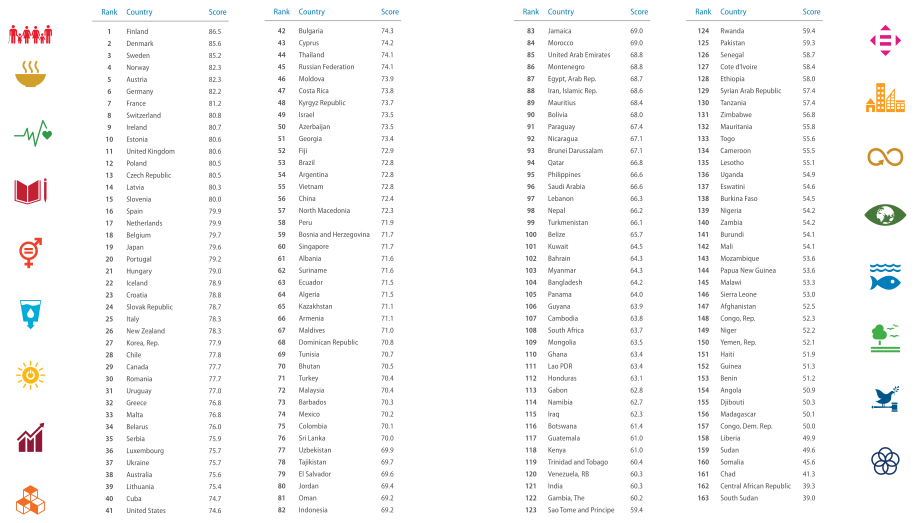
The 2022 SDG Index is topped by Finland, followed by three Nordic countries –Denmark, Sweden and Norway – and all top 10 countries are European countries. Yet even these countries face major challenges in achieving several SDGs. Overall, East and South Asia is the region that progressed most on the SDGs since their adoption in 2015. Bangladesh and Cambodia are the two countries that progressed most on the SDGs since 2015. By contrast Venezuela has declined the most on the SDG Index since their adoption in 2015.

A global plan to finance sustainable development is urgently needed.

Achieving the SDGs is fundamentally an investment agenda in physical infrastructure (including renewable energy, digital technologies) and human capital (including health, education). Yet the poorest half of the world lacks market access to capital on acceptable terms. Poor and vulnerable countries have been hit hard by the multiple crises and their spillovers. Rising budget pressures, increased military spending and major shifts in strategic priorities, especially in European countries, might squeeze development funds available to support sustainable development globally. In this context, the report presents a five‐point plan for financing the SDGs globally. It underlines the key role of the G20, International Monetary Fund (IMF) and Multilateral Development Banks (MDBs) to expand SDG financing globally.

At mid‐point on the way to 2030, policy efforts and commitments for the SDGs vary greatly.

At mid‐point on the way to 2030, the integration of the SDGs into policies, regulations, budgets, monitoring systems, and other government policies and procedures still varies greatly across countries. Among G20 member states, the United States, Brazil, and the Russian Federation exhibit the least support for the 2030 Agenda and the SDGs. By contrast, Nordic countries demonstrate relatively high support for the SDGs, as do Argentina, Germany, Japan and Mexico (all G20 countries). Some countries, such as Benin and Nigeria, for example, have large gaps in their SDG Index yet also earn relatively high scores for their policy efforts. Interestingly, Benin and Mexico have both issued SDG Sovereign Bonds in recent years to scale up their sustainable development investments.

For the second time since their adoption in 2015, UN Member States will meet in September 2023 on the side‐line of the UN general Assembly for the SDG Summit to define priorities for restoring and accelerating SDG progress by 2030 and beyond. Ambitious and sound national targets, strategies, and plans are crucial to turning the SDGs into an action agenda.

Other findings of the Sustainable Development Report 2022:

  • Rich countries generate negative international spillovers notably through unsustainable consumption. The 2022 international Spillover Index included in this report underlines how rich countries, generate negative socioeconomic and environmental spillovers, including through unsustainable trade and supply chains.
  • New partnerships and innovations that emerged during the COVID‐19 pandemic, including in scientific cooperation and data, should be scaled‐up to support the SDGs. Science, technological innovations, and data systems can help identify solutions in times of crises and can provide decisive contributions to address the major challenges of our times. These call for increased and prolonged investments in statistical capacities, R&D, and education and skills.

Since 2015, the SDR provides the most up‐to‐date data to track and rank the performance of all UN member states on the SDGs. The report was written by a group of independent experts at the Sustainable Development Solutions Network (SDSN), led by its President, Prof. Jeffrey Sachs. The report is produced by SDSN, published by Cambridge University Press, and co‐funded by Bertelsmann Stiftung.

2022 SDG Index ranking and score

Contacts

Guillaume Lafortune | guillaume.lafortune@unsdsn.org | +33 (0) 6 60 27 57 50
Vice President & Head of the Paris Office, Sustainable Development Solutions Network (SDSN)

Dr. Christian Kroll | c.kroll@alumni.lse.ac.uk
Co-Author of the report

Maëlle Voil | media@unsdsn.org | +33 (0) 6 99 41 70 11

About SDSN

The UN Sustainable Development Solutions Network (SDSN) mobilizes scientific and technical expertise from academia, civil society, and the private sector to support practical problem solving for sustainable development at local, national, and globalscales. The SDSN has been operating since 2012 under the auspices of the UN Secretary‐General. The SDSN is building national and regional networks of knowledge institutions, solution‐focused thematic networks, and the SDG Academy, an online university for sustainable development.