ZBOR: a space for young people in Romania to explore their dreams

Interview with Nicoleta Deliu Pașol, Head of Communication and CSR at BCR

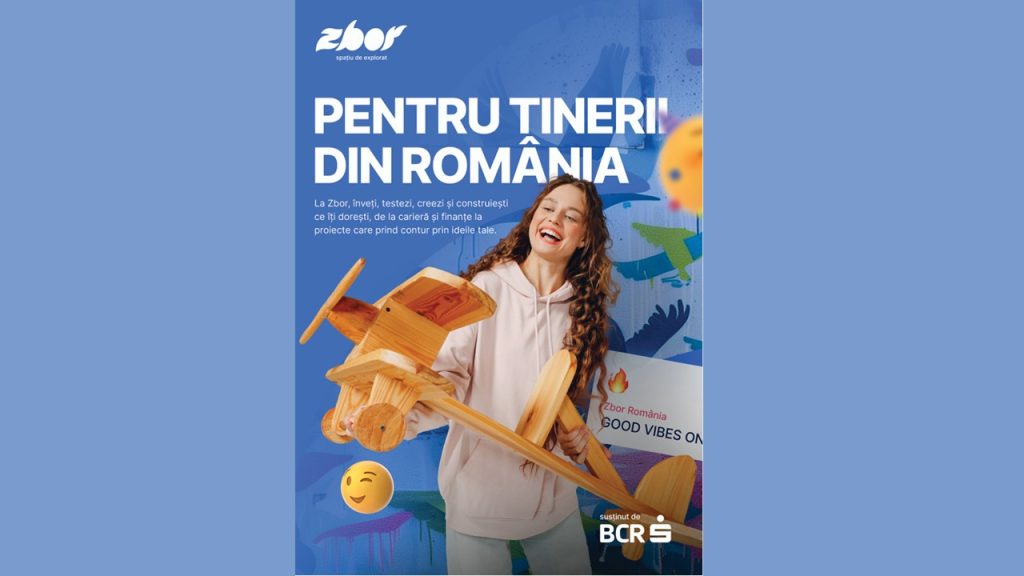
Launched by BCR as a bold educational transformation initiative, ZBOR is more than just a project – it is a network of hubs designed to meet the real needs of young people in Romania.

In a context where safe spaces for learning and exploration are almost entirely lacking, ZBOR provides an environment where curiosity, free expression, and authentic dialogue are encouraged.

With 7 operational hubs currently and a unified curriculum that covers financial education, entrepreneurship, sustainability, digital literacy, and personal development, ZBOR aims to become a scalable intervention model that supports a generation asking to be heard, understood, and empowered. In this interview with Nicoleta Deliu Pașol, Head of Communication and CSR at BCR, we explore how the project came to life, the challenges it faced, and BCR’s vision for the coming years.

1.  How was the educational content of the ZBOR project designed, and what real needs of young people does it address?

Even before launching ZBOR, we had spent many years working with young people at BCR through national initiatives like the Money School. From the beginning, we built a relationship based on mutual learning. We introduced them to the world of financial education, and they taught us about their generation. Today’s youth are ambitious, adaptable, and eager for change, but they often lack spaces designed for them – places where they can explore, dream, and make mistakes in a safe and inclusive environment. That real need was our starting point when developing the educational content for ZBOR. We took time to listen to young people and truly understand them. We realized they need to be heard in order to gain confidence in themselves and their aspirations.

With the way we develop ZBOR’s curriculum, our goal is to democratize access to education by offering the same quality of content to all young people across Romania – from small towns to the heart of Bucharest. In addition to local, contextualized activities adapted to each hub, it is equally important to have a shared curriculum used across all cities where a ZBOR hub exists.

We co-create the educational content with experts from various fields who design courses in a language young people relate to. The current curriculum covers five main areas: financial education, entrepreneurship, sustainability, digital education, and personal development.
2 .  What have been the biggest challenges in launching the seven hubs?

One of the biggest challenges? Making the space feel… natural. A place between school and home where young people genuinely feel like they belong. In a context where such spaces are almost entirely absent from our urban culture, we started from scratch – building not just physical places but also relationships of trust and communities of young people around the project.

One important lesson was related to the consumption behaviour of the new generation. Gen Z spends most of its time in digital environments and finds a sense of community there. That’s why one challenge was showing them that a physical space, if co-created with them, can also become relevant, safe, and authentic.

We adjusted along the way: the space is open even outside of planned activities, we encouraged informal gatherings, spontaneous participation, and co-creation of programs. ZBOR is a living process, where we learn together with young people and constantly adapt – with empathy, patience, and a strong belief that trust is built over time, through real presence and open dialogue.

3. What role does BCR aim to play in the development of young people in Romania?

ZBOR is a space for exploration, for real questions, personal rhythm, and confidence in each young person’s potential. Through ZBOR, we bring young people closer to useful resources, safe communities, and mentors who offer patience, not pressure. We create contexts in which honest conversations about money, the future, and life choices become a natural part of their journey.

Trust is built over time, with small steps and continuous support – exactly what ZBOR brings into the community.

4.  What have you learned from the first months of operation, and what would you change?

So far, something we already sensed from previous projects has been confirmed – young people in Romania are curious, creative, and bold. They need trust and support to truly spread their wings. They want to be heard, and they want their ideas to matter – things they can find at ZBOR. We’d love to expand our educational activities even further, to respond better to the needs they express – whether directly or through their actions.

We continue to learn alongside them. Every day. But one thing is clear: when they’re offered space, support, and resources, they know exactly what they want. That’s why we are here not just to support them, but to work with them – with respect, curiosity, and mutual trust.

5.  How do you envision the expansion of the project over the next 2-3 years?

Expanding the project over the next 2-3 years means more than just opening new hubs. ZBOR comes with a cultural shift: recognizing the role that young people can play in social, economic, and civic life. In the years ahead, we hope ZBOR will become a scalable model of intervention for younger generations – with measurable impact in education, employability, and civic engagement. And we’re building that path together, step by step, with trust and perseverance.

The interview was initially published in the bilingual yearbook Sustainability Index Magazine no. 3. You can flip through it here: https://sustainabilityindex.ro/sustainability-index-magazine-2025/

Proiectul ZBOR: spațiu de explorat pentru visurile tinerilor din România

Interviu cu Nicoleta Deliu Pașol – Head of Communication and CSR, BCR

Lansat de BCR ca un demers curajos de transformare educațională, ZBOR este mai mult decât un proiect – este o rețea de hub-uri gândite pentru a răspunde nevoilor reale ale tinerilor din România. Într-un context în care spațiile sigure de învățare și explorare lipsesc aproape cu desăvârșire, ZBOR oferă un cadru în care curiozitatea, exprimarea liberă și dialogul autentic sunt încurajate.

Cu 7 hub-uri funcționale în prezent și un curriculum unitar care acoperă educația financiară, antreprenoriatul, sustenabilitatea, educația digitală și dezvoltarea personală, ZBOR își propune să devină un model scalabil de intervenție în sprijinul unei generații care cere să fie ascultată, înțeleasă și sprijinită.

În acest interviu cu Nicoleta Deliu Pașol, Head of Communication and CSR la BCR, descoperim cum s-a născut proiectul, ce provocări a întâmpinat și cum arată viziunea BCR pentru următorii ani.

1. Cum a fost conceput conținutul educațional al proiectului ZBOR și pe ce nevoi reale ale tinerilor se bazează?

Chiar dinainte de a lansa ZBOR, am lucrat mulți ani cu tinerii la BCR în proiecte naționale ca Școala de Bani. De la bun început, am creat împreună o relație bazată pe învățare reciprocă. Noi i-am introdus în universul educației financiare, iar ei ne-au învățat despre generația lor. Tinerii de azi au ambiție, adaptabilitate și dorință de schimbare, dar se lovesc de lipsa unor spații create pentru ei, unde pot explora, visa și greși într-un mediu sigur și incluziv. De la această nevoie reală am pornit atunci când am dezvoltat conținutul educațional al proiectului ZBOR. Am stat de vorbă cu tinerii și am vrut să-i înțelegem. Ne-am dat seama că au nevoie să fie ascultați pentru a putea căpăta încredere în ei și în aspirațiile lor.

Prin modul în care dezvoltăm curriculumul ZBOR, ne dorim să democratizăm accesul la educație  oferind același gen de conținut tuturor tinerilor din România – de la cei din orașe mici până la cei din inima Bucureștiului. Cu alte cuvinte, pe lângă activități contextualizate, adaptate fiecărui hub în parte, este important să avem un curriculum comun care să fie folosit în toate orașele în care există un hub ZBOR. Gândim conținutul educațional alături de experți din diferite domenii care creează cursuri pe limba tinerilor. Curriculumul actual acoperă cinci zone: educație financiară, antreprenoriat, sustenabilitate, educație digitală și dezvoltare personală.

2.  Care sunt cele mai mari provocări pe care le-ați întâlnit în lansarea celor 7 hub-uri?

Una dintre cele mai mari provocări? Să facem spațiul terțiar să pară… firesc. Un loc între școală și acasă, unde tinerii să simtă că e al lor, cu adevărat. Într-un context în care astfel de spații lipsesc aproape complet din cultura noastră urbană, am pornit de la zero, construind nu doar un loc fizic, ci și o relație de încredere, comunități de tineri în jurul proiectului.

Una dintre lecțiile importante a fost legată de comportamentul de consum al noii generații. Tinerii din Gen Z își petrec majoritatea timpului în medii digitale și găsesc acolo sensul de comunitate. Tocmai de aceea, una dintre provocări a fost să le arătăm că și un spațiu fizic, dacă e construit împreună cu ei, poate deveni un loc relevant, sigur și autentic.

Am ajustat din mers: spațiul este deschis și în afara activităților planificate, am încurajat întâlnirile informale, participarea spontană, co-crearea programelor. ZBOR este un proces viu, în care învățăm alături de tineri și adaptăm constant – cu empatie, cu răbdare și cu o convingere fermă că încrederea se clădește în timp, prin prezență reală și dialog deschis.

3.  Ce rol își propune BCR să joace în dezvoltarea tinerilor  din România?

ZBOR este un spațiu de explorat, un spațiu pentru întrebări reale, ritm personal și încredere în potențialul fiecărui tânăr. Prin ZBOR, aducem aproape de tineri cu resurse utile, comunități sigure și mentori care oferă răbdare, nu presiune. Construim contexte în care conversațiile sincere despre bani, viitor și alegeri devin parte din parcursul tinerilor. Încrederea se formează în timp, cu pași mici și sprijin constant – exact ceea ce aduce și ZBOR în comunitate.

4.  Ce ați învățat după primele luni de funcționare și ce ați schimba?

Până acum, ni s-a confirmat ceva ce știam deja din proiectele anterioare – tinerii din România sunt curioși, creativi și îndrăzneți. Au nevoie de încredere și sprijin pentru a-și putea întinde aripile. Vor să fie ascultați și vor ca ideile lor să conteze – lucruri pe care le pot găsi la ZBOR. Ne-ar plăcea să extindem activitățiile educaționale, pentru a răspunde și mai bine nevoilor pe care le exprimă direct – cu voce tare sau prin faptele lor.

Învățăm în continuare alături de tineri. Zilnic. Dar un lucru e clar: atunci când li se oferă spațiu, susținere și resurse, știu foarte bine ce vor. Și tocmai de aceea suntem aici nu doar pentru a-i susține, ci pentru a lucra împreună – cu respect, curiozitate și încredere reciprocă.

5.  Cum vedeți extinderea proiectului în următorii 2-3 ani?

Extinderea proiectului în următorii 2-3 ani înseamnă mai mult decât deschiderea unor noi huburi.  ZBOR vine la pachet cu o schimbare culturală: recunoașterea rolului pe care tinerii îl pot juca în viața socială, economică și civică.

Ne dorim ca, în următorii ani, ZBOR să devină un model scalabil de intervenție pentru generațiile tinere – cu impact măsurabil în educație, angajabilitate și implicare civică. Iar acest drum îl construim împreună, pas cu pas, cu încredere și perseverență.

Interviu acordat în exclusivitate pentru anuarul bilingv Sustainability Index Magazine nr. 3. Acesta poate fi vizualizat aici în varianta digitală: https://sustainabilityindex.ro/sustainability-index-magazine-2025/

Digitalisation is a Clear Enabler for The Green Transformation of Our Society

Digitalisation is a Clear Enabler for The Green Transformation of Our Society

Ilinka Kajgana is an innovative and engaging risk leader whose 17 years of international work experience in large and complex banking organizations has delivered outstanding results. Her deep technical expertise across modelling and data, complex products and refined risk sensitivities is complemented by her consistent ability to partner with the business environment to drive risk-controlled growth.

In her current role as Chief Risk Officer for BCR, she has transformed the bank’s status and performance, obtaining a “low risk” rating following an ECB Supervisory Review and Evaluation Process. She also spearheaded innovation through the launch of a fully-fledged ESG transformation programme, central to business strategy.

The interview was initially published in the bilingual yearbook Community Index Magazine no. 5. You can flip through it here: https://communityindex.ro/community-index-magazine-2023/

  1. What impact has sustainability had on your strategic planning in the last year?

Sustainability is one of the main pillars of our company strategy, not only in the last year but also in the years to come. It marks everything we do: from the way we evaluate risk to the way we train our people, from the way we look at the development opportunities ahead to the way we operate in our offices.

On a very concrete level, 100% of the cards issued by BCR from January 2023 onwards, for private individual and corporate customers, are made of environmentally friendly materials, both recycled plastic and biodegradable material. BCR started issuing environmentally friendly cards as early as 2021, and so far about 50% of the portfolio is issued on sustainable material. Also, the green mortgage loan ’Casa Mea, NaturA’ accounted for about 44% of the total standard mortgage volumes disbursed by BCR in H1 2023. The loan is granted for buildings with an A energy certificate or for the greenhouses certified by the Romanian Green Building Council.

We continued the roundtables series on the ESG transformation of the Romanian companies, organized by BCR in partnership with ECOTECA Association, with the involvement of institutional representatives, entrepreneurs and ESG experts. In March, together with the Academy of Economic Studies in Bucharest, we developed the topic of “Establishing and measuring ESG indicators”, and in June, together with EFdeN, we discussed about „Energy efficiency in buildings: best practices and challenges.

2. What ESG actions does BCR take today to help future generations meet their needs?

 All our programs that are dedicated to future generations have one common denominator: education.

We have an integrated approach towards green education and digital education since we believe that digital transformation is a clear enabler for the green transformation of our society. Therefore, 66,000 Romanians participated in a Money School class, with a 50% increase in active users on Money School Platform.

We also have a partnership with NextLab Tech, the most important digital competition from South-Eastern Europe, where more than 60.000 children developed their skills for the future. Also, we have an integrated approach towards financial education and green education.

This is the underlying philosophy of our programmes: on one hand, the integration of digital and green education, on the other hand, the integration of financial and green education. Besides, we try to give young people a better understanding of what a job means today. Apart from our ongoing programmes of internships and career workshops, BCR has a strategic partnership with Joblandia, the innovative solution in education that matches highschool students and companies for a practical experience during “Saptamana Altfel” (The Alternative Education Week). In 2023, more than 3000 teenagers were enrolled in this programme, powered by BCR.

3. The fight against climate change has become pivotal for any responsible company. How does it affect your company and how do you fight to reduce its negative impact?

In the medium term, climate change will have a more significant impact on some economic segments such as agriculture, energy, construction, and possibly tourism. Our role is to support our clients from these segments into adapting their strategies for the future, to find alternatives and to invest in sustainability.

On the bright side, the recent pandemic produced an acceleration of the transition towards sustainability: hybrid work has significantly reduced the carbon footprint of the companies and has created a deeper sense of awareness towards the impact of global challenges. However, change has to be created person by person. In BCR, we have a ongoing training module about ESG that is mandatory for all our colleagues.

We have observed that no matter which generation colleagues are -Gen Z, Millenials, Gen X- they are very eager to enrol into saving resources while embracing a more environmentally-friendly routine. There is a long journey in front of us but at least there are more people who are seeing the importance of this road and who are trying to create a sensible map.

4. Banks can have a huge influence when choosing their ESG criteria for giving loans. What are BCR’s steps in this direction?

We try to position ourselves as a committed companion of our clients in their journey towards sustainability and ESG transformation. We believe that ESG is not only about compliance and ticking some boxes with the Environment, Social and Governance labels. It is about changing profoundly the way of doing business as a company.

Therefore, our role is to actively support our clients in their process of getting access to green finance. We are all in a process of learning, therefore being transparent and open is of critical importance for transitioning towards an ESG society.

We try to explain to our clients that sustainability is the most important investment: it means care for future generations and for the planet we leave to our children. On a more pragmatic note, getting access to green finance creates real business opportunities while staying relevant in the international value chain.

5. In May 2023 you had your first green Eurobond bank transaction. What were your aims with this issuance?

BCR’s green bond issue was a first on the Romanian financial-banking market, being the largest corporate bond issuance in Romania.

The bond issue proved successful from the outset, as the order book registered a significant volume of EUR 1.9 billion, well above the minimum issue size of EUR 500 million. This increased the issued amount to EUR 700 million. The final volume reflects our commitment to the market in terms of future issuance plans and our aim of building a relationship of trust with our investors.

It is also a signal of trust in the potential of the green economy of our region. A signal of trust for a greener future.

6. How about your social impact, where do you stand and what are your latest achievements?

Let us review some clear benchmarks because I believe that, in sustainability, it is important to walk the talk. In 2022, the social impact of the BCR Group (the banking services for NGO-s and social enterprises) generated the following impact: 290.000 beneficiaries from vulnerable categories, 1800 jobs supported or created (including jobs for vulnerable persons), 2.5 million Euros for developing associations and social enterprises, 127 NGO-s included in training or acceleration programmes, 900 NGO-s enrolled in The Good Exchange (Bursa Binelui), the only donor platform without commission. Besides, at InnovX-BCR, we accelerated 32 start-ups so that the local tech business got access to 19,7 million euros.

I should add that more than 21000 local entrepreneurs had free access to entrepreneurial education on the platform Școala de Business (School of Business).

Not in the least, we have 5000 employees – they are the engines that will really move Romania towards sustainability.

Ilinka Kajgana’s Biography

Since joining the Erste Bank Group in 2006, Ilinka has taken on and executed strategic projects for the business, including Operational risk, Capital Adequacy, AMA and other priorities for both the group and its international network of savings banks (Sparkassen). As a member or chair of the supervisory board, or board of directors for a number of entities over the past five years, she has helped guide the strategic direction of the group and put in place frameworks, policies, processes and controls to optimize clarity and efficiency, as well as mitigate risk.

She adopts new technology and uses agile methodologies to transform businesses, aligning them to the evolving needs of our clients and an increasingly complex international regulatory environment. Her scientific background, Master’s and PhD, have all honed her problem-solving and analytical skills. Building trusted relationships with key stakeholders in large and complex organizations has been a key facet of her success, and is complemented by an ability to engage with the regulator, clients, partners and suppliers.

Case Study: The Money School – education for smart financial choices

Case Study: The Money School – education for smart financial choices

Project strategy

Money School is a financial education program developed by the Romanian Commercial Bank. Launched in 2016, it started from the need to educate Romanians financially. Over 1,500 BCR employees have become financial education teachers for more than 500,000 Romanians.

In 2022, the Money School set out to create even more impact, right where education starts: in school and in the family.

Objectives of the program:

• Financial education for over 60,000 Romanians;

• Developing an intervention in the educational system to prepare future generations for smart financial choices;

• Contribution to improving the standard of living of Romanians.

Stakeholder engagement

In 2022, the Money School online learning platform added 4 new courses:

• 2 courses for adults, together with Mai Mult Verde Association, psychologist Raluca Anton and BCR experts;

• 2 financial education courses for children: with Itsy and Bitsy and Pepper the robot.

BCR specialists and Școala de Valori Association helped 52,000 students and adults make smart financial choices through workshops organized throughout the country.

On the occasion of the first national day of Financial Education, on April 11th, BCR and Școala de Valori Association organized #EduFin Fest, the first festival dedicated to financial education in Romania. More than 2,500 students from more than 30 counties participated in 100 non-formal education events where BCR employees, entrepreneurs and local personalities provided them with information to make better financial decisions.

In addition, to bring financial education closer to students and teachers, in September 2022, BCR and the Money School launched LifeLab, a pilot program of financial education and development of students’ life skills, run together with FabLab and the Association Edupedu.

The program involved more than 1,200 students and more than 50 teachers. LifeLab brought to the school system a hands-on education format with an interdisciplinary approach, through which the notions of financial education were introduced within a varied series of subjects from all education cycles. Through experiential learning, students understand the connection between financial education and the fulfilment of desires, and learn analytical, collaborative and planning skills useful for the future. Teachers involved in the program become „life teachers”, act as mentors for their students and help them achieve their dreams with financial education.

Alignment with business and industry

BCR, through the Money School, pursues a systemic intervention to financially educate Romanians of all ages.

Socio-economic Analyses

The World Bank placed Romania last out of 127 countries from the perspective of financial education (2018). This exposes Romanians to vulnerability, and wrong financial choices affect the level of satisfaction and quality of life.

99% of teachers believe there is a clear need to teach financial education in schools (2022). Both teachers and students need practical financial education content with examples and exercises.

Impact and communication of the program

In 2022, over 66,000 children, young people and adults benefited from financial education through the Money School, the largest financial education program in Romania. Since the launch of the program, over 600,000 Romanians have had the opportunity to learn how to make smart financial decisions. As a consequence:

• Beneficiaries have become more aware of the importance of accurate money management;

• Participants in the financial education workshops started saving, investing and dividing their budget according to the 20/50/30 rule;

• Adults started shopping with a list, thinking long-term and dividing their budget taking into account needs and then wants;

• 80% of those who saw the Money School messages remembered the main rules.

The Case Study is also published in the bilingual yearbook Community Index Magazine no. 5. You can flip through it here: https://communityindex.ro/community-index-magazine-2023/