
Interview with Nicoleta Deliu Pașol, Head of Communication and CSR at BCR
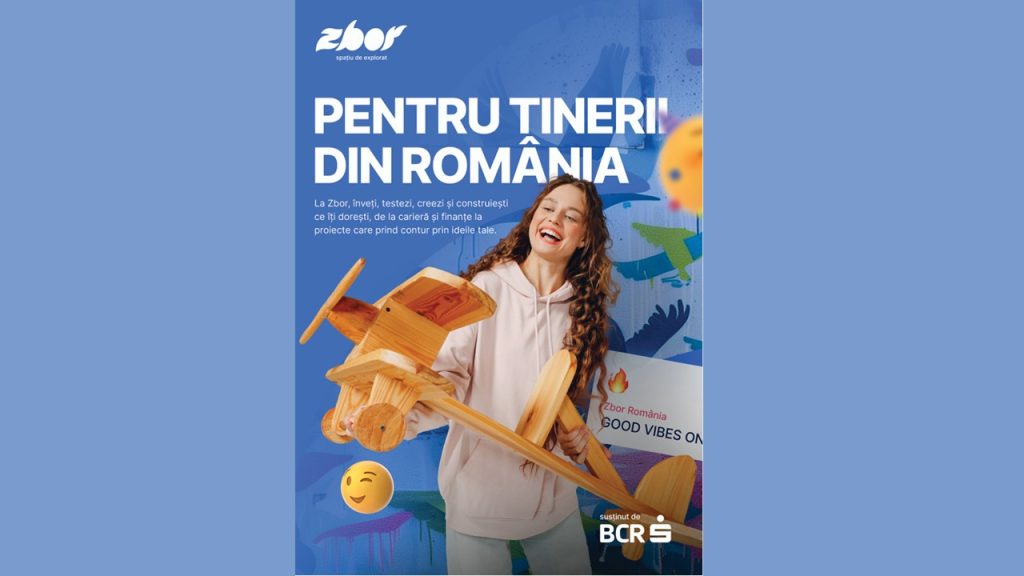
Launched by BCR as a bold educational transformation initiative, ZBOR is more than just a project – it is a network of hubs designed to meet the real needs of young people in Romania.
In a context where safe spaces for learning and exploration are almost entirely lacking, ZBOR provides an environment where curiosity, free expression, and authentic dialogue are encouraged.
With 7 operational hubs currently and a unified curriculum that covers financial education, entrepreneurship, sustainability, digital literacy, and personal development, ZBOR aims to become a scalable intervention model that supports a generation asking to be heard, understood, and empowered. In this interview with Nicoleta Deliu Pașol, Head of Communication and CSR at BCR, we explore how the project came to life, the challenges it faced, and BCR’s vision for the coming years.
1. How was the educational content of the ZBOR project designed, and what real needs of young people does it address?
Even before launching ZBOR, we had spent many years working with young people at BCR through national initiatives like the Money School. From the beginning, we built a relationship based on mutual learning. We introduced them to the world of financial education, and they taught us about their generation. Today’s youth are ambitious, adaptable, and eager for change, but they often lack spaces designed for them – places where they can explore, dream, and make mistakes in a safe and inclusive environment. That real need was our starting point when developing the educational content for ZBOR. We took time to listen to young people and truly understand them. We realized they need to be heard in order to gain confidence in themselves and their aspirations.
With the way we develop ZBOR’s curriculum, our goal is to democratize access to education by offering the same quality of content to all young people across Romania – from small towns to the heart of Bucharest. In addition to local, contextualized activities adapted to each hub, it is equally important to have a shared curriculum used across all cities where a ZBOR hub exists.
We co-create the educational content with experts from various fields who design courses in a language young people relate to. The current curriculum covers five main areas: financial education, entrepreneurship, sustainability, digital education, and personal development.
2 . What have been the biggest challenges in launching the seven hubs?
One of the biggest challenges? Making the space feel… natural. A place between school and home where young people genuinely feel like they belong. In a context where such spaces are almost entirely absent from our urban culture, we started from scratch – building not just physical places but also relationships of trust and communities of young people around the project.
One important lesson was related to the consumption behaviour of the new generation. Gen Z spends most of its time in digital environments and finds a sense of community there. That’s why one challenge was showing them that a physical space, if co-created with them, can also become relevant, safe, and authentic.
We adjusted along the way: the space is open even outside of planned activities, we encouraged informal gatherings, spontaneous participation, and co-creation of programs. ZBOR is a living process, where we learn together with young people and constantly adapt – with empathy, patience, and a strong belief that trust is built over time, through real presence and open dialogue.
3. What role does BCR aim to play in the development of young people in Romania?
ZBOR is a space for exploration, for real questions, personal rhythm, and confidence in each young person’s potential. Through ZBOR, we bring young people closer to useful resources, safe communities, and mentors who offer patience, not pressure. We create contexts in which honest conversations about money, the future, and life choices become a natural part of their journey.
Trust is built over time, with small steps and continuous support – exactly what ZBOR brings into the community.
4. What have you learned from the first months of operation, and what would you change?
So far, something we already sensed from previous projects has been confirmed – young people in Romania are curious, creative, and bold. They need trust and support to truly spread their wings. They want to be heard, and they want their ideas to matter – things they can find at ZBOR. We’d love to expand our educational activities even further, to respond better to the needs they express – whether directly or through their actions.
We continue to learn alongside them. Every day. But one thing is clear: when they’re offered space, support, and resources, they know exactly what they want. That’s why we are here not just to support them, but to work with them – with respect, curiosity, and mutual trust.
5. How do you envision the expansion of the project over the next 2-3 years?
Expanding the project over the next 2-3 years means more than just opening new hubs. ZBOR comes with a cultural shift: recognizing the role that young people can play in social, economic, and civic life. In the years ahead, we hope ZBOR will become a scalable model of intervention for younger generations – with measurable impact in education, employability, and civic engagement. And we’re building that path together, step by step, with trust and perseverance.
The interview was initially published in the bilingual yearbook Sustainability Index Magazine no. 3. You can flip through it here: https://sustainabilityindex.ro/sustainability-index-magazine-2025/
